
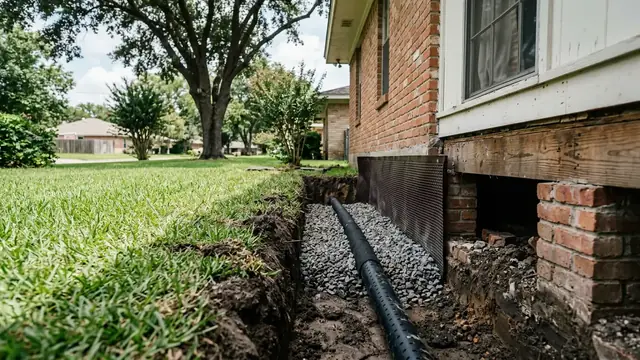
Foundation drain trench - ai picture
Foundation drainage keeps rain from collecting against a slab (the concrete base of the house) or under a raised floor. In Houston it usually starts with shaping the soil so it slopes away from the house, and carrying roof water off in pipes. A drain along the house catches any water that still gathers. Under a raised house, water can reach the crawl space (the low, open space under some houses). There, a crawl space sump pump (a pump that pushes water out when it cannot flow downhill) removes it.
The estimate is free, and you do not have to hire anyone. The work starts outside and moves in.
Why does water near the foundation matter on Houston clay?
Houston's clay swells when it soaks up water and shrinks again as it dries. The City of Houston's emergency office notes that local clays often swell by 10 percent or more as they take in water. The office describes the wet-dry cycle as a repeated stress on buildings. Good foundation drainage keeps one side of the house from soaking while the rest stays dry.
Water collects at a foundation for ordinary reasons, and most of them can be fixed. A downspout (the pipe that brings rain down from the roof) may empty at the wall. Flower beds may sit higher than the lawn and hold water against the wall. A patio may tilt back toward the house, or the yard may sit lower than its neighbors.
Slab or pier and beam: what changes?
The main change is where the work happens: all outside on a slab home, and outside plus in the crawl space on a raised home. Most newer Houston homes sit on a concrete slab, and basements are rare here. In 2024, 97.9 percent of new single-family homes in this part of the country were built on slabs. That comes from census figures reported by the National Association of Home Builders. Many older homes, like those in the Heights (an older Houston neighborhood), sit on short posts called piers, above a crawl space.
The City of Houston's historic district manual for the Heights describes those houses as raised on piers. The first floor sits about 2.5 to 3 feet above the ground. Water that runs under the house sits on the soil there, out of sight, and keeps the air under the floor damp.
On a slab home, the water stays outside against the slab edge. On a raised home there are two jobs: stop water reaching the crawl space, and remove what still gets in.
What should be fixed first around the foundation?
Start with the cheap fixes outside, because they stop most of the water before it reaches the house. Regrading (reshaping the ground so it slopes the right way) makes the soil slope away from the walls. Carry roof water off in buried pipe, and only then decide whether a drain or a pump is still needed.
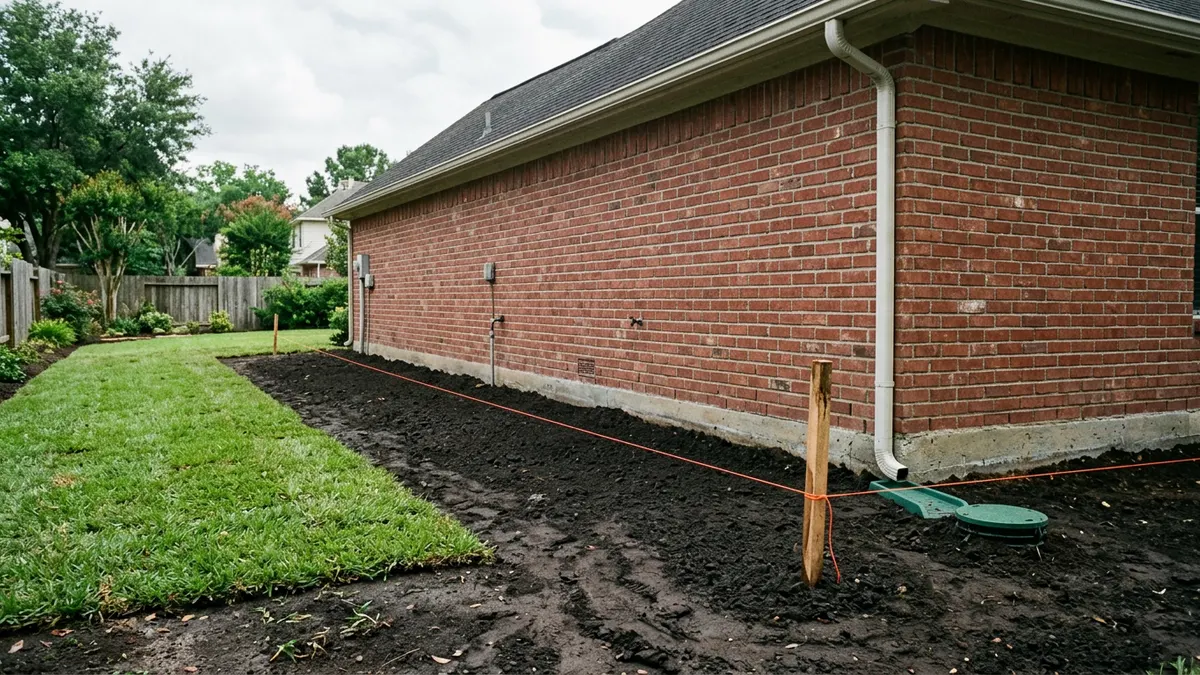
- Slope the first 10 feet. The International Residential Code (a standard set of home-building rules) sets the target: soil that drops 6 inches over the 10 feet nearest the walls. Flower beds that trap water get reshaped, which is part of regrading the soil around the house.
- Move roof water. Downspout drainage that carries water away in solid pipe often solves the problem, because downspouts that empty at the wall are a common source.
- Catch what still arrives. Sometimes water keeps coming from a neighbor's higher yard or a slope. Then a French drain (a trench filled with gravel, with a pipe at the bottom) can catch it before it reaches the house. It can be a perimeter French drain along the house, or a curtain drain across the slope uphill of the house.
- Pump out what gathers below. If water still pools under a raised floor, a crawl space sump pump removes it.
Often the first two steps are enough, and the site visit shows which steps apply.
How is a perimeter or curtain drain built near a house?
A perimeter drain is a French drain along the side of the house where water arrives, to catch it before it gets to the foundation. A curtain drain is the same build, placed across a slope a little uphill of the house.
Beside a house on clay, the trench is often dug more than 2 feet deep. Its sides and bottom are lined with filter fabric (a cloth that lets water in but keeps soil out). Inside, a 4-inch perforated pipe (plastic pipe with small holes) sits in clean, washed rock and leads to the outlet. Near a foundation, the trench sits a short distance out from the slab edge, not tight against it. Roof water stays in its own solid pipe and never feeds the drain pipe.
On flat ground, the outlet (the place where the water comes out) decides the design. The water may leave at the curb or in a lower part of the yard. Or it may go to a pit with a pump in it, where a yard sump pump for outside water pushes it out.
When does a crawl space need a sump pump?
A crawl space needs a pump when water stands on the ground under the house after rain and cannot drain away. A pit is dug at the lowest point, and the pump sits in it.
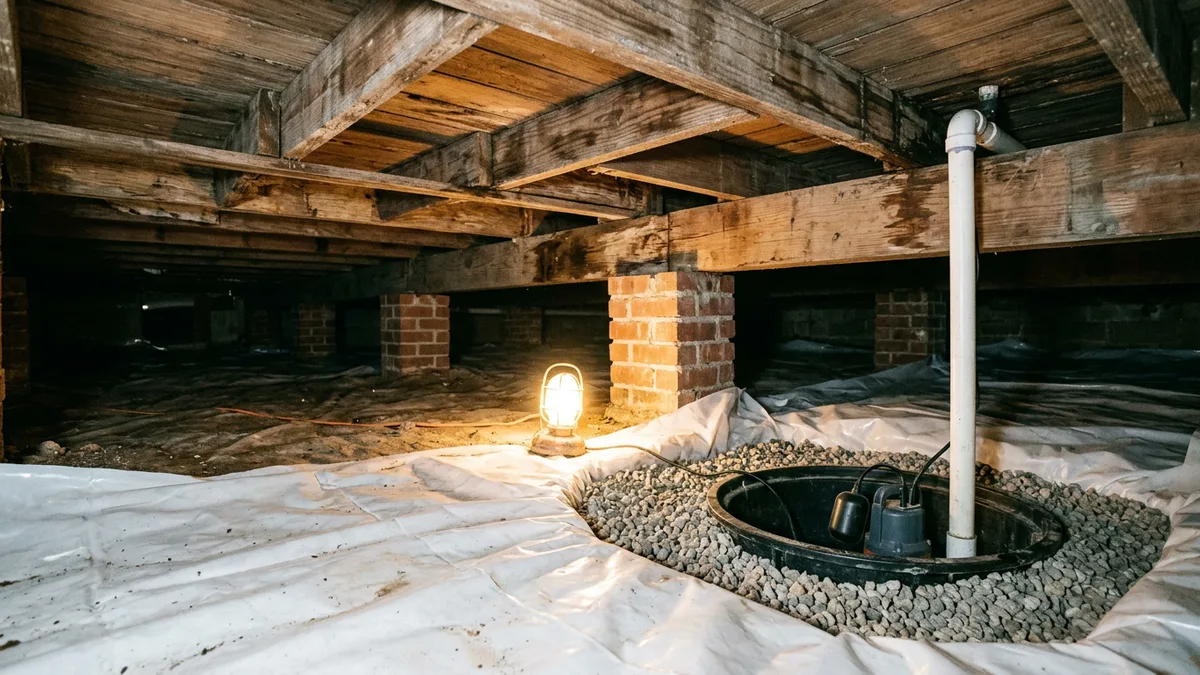
A float switch (a switch that floats up as the water rises) turns the pump on. A pipe carries the water outside and well away from the house.
The usual setup:
- A basin where the floor dips. A plastic basin, often 18 to 24 inches wide, set in gravel at the lowest point.
- Collection. In wetter crawl spaces, a shallow drain along the inside edge feeds the pit.
- Pump and check valve. A small pump pushes the water out through a narrow pipe, and a one-way valve stops it flowing back into the pit.
- Outlet outside. The pipe leaves through the wall or the lattice panel around the base of the house. It joins a buried line to an outlet, so the water never lands beside the piers.
- Ground cover. A vapor barrier (a plastic sheet over the soil) keeps the damp ground from wetting the air under the floor.
Sump pumps often last about ten years, so test an older one before storm season.
What does foundation drainage cost in Houston?
The cost depends on which steps your house needs. Based on several national cost guides, a crawl space sump pump with a new pit costs about $750 to $1,800 installed. A deeper drain built for clay runs about $35 to $80 per foot, and regrading about $700 to $4,500. These are national figures, and Houston quotes vary with the lot.
For example, at those rates a drain along one 50-foot side costs about $1,750 to $4,000, before the outlet. Downspout lines and regrading usually cost less. For the full breakdown, see what foundation drainage costs in Houston.
Foundation and crawl space drainage work covers Houston and nearby towns such as Pearland, League City and The Woodlands. It fits older raised homes in the Heights and newer slab homes in the suburbs.
Getting an Accurate Quote for Foundation Drainage in Houston
Call the number above or fill in the form below to get a free quote with no obligation.
FAQ
Disclaimer: The information on this page is for general information only. It should not be taken or relied on as engineering, construction, legal, financial or other advice. It is based on information that was publicly available at the time of writing, and it may have changed since. It may be inaccurate or incomplete. Always consult a professional. You use this information at your own responsibility and risk, and we take no responsibility for it.
Some content may be written with AI and then reviewed by a person.