
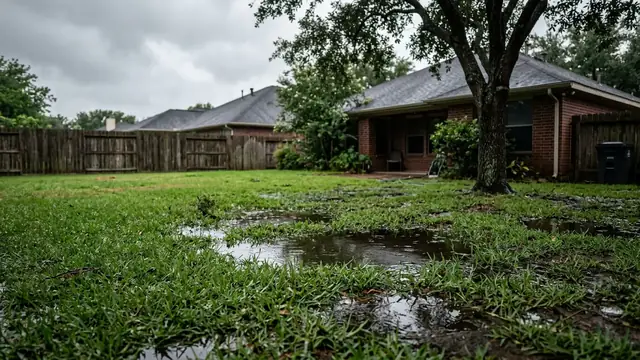
Flooded backyard lawn - ai picture
Yard drainage in Houston means moving rain off a flat yard with heavy clay soil to a place where it can go. The fix is usually one of four things, and one is a French drain (a trench filled with gravel, with a pipe at the bottom). Others are a catch basin (a box in the ground with a grate on top), regrading (reshaping the ground) or a small sump pump (a pump that pushes water out). The right one depends on where your water sits and where it can leave.
Why do Houston yards stay wet after the rain stops?
Most Houston yards stay wet for two reasons: the ground is nearly flat, and the soil is heavy clay that takes in water slowly. Rain has little room to run off or soak in, so it sits on the lawn. A yard drainage system gives it a way out.
Start with the rain. Bush Intercontinental Airport (Houston's main weather station) gets 51.84 inches of rain a year on average (a 30-year average for 1991-2020), often in bursts. NOAA (the US weather agency) publishes Atlas 14 rainfall estimates. In downtown Houston, a 10-year storm (a 1 in 10 chance each year) drops 8.74 inches in 24 hours. A 100-year storm (1 in 100) drops 17.0 inches. A yard has to handle the burst, not the yearly average.
Then look at the ground. Much of Houston sits on gumbo (the local name for sticky grey-black clay). The US Department of Agriculture's soil descriptions call it the Lake Charles and Beaumont clays. This clay swells when wet and gets smaller when dry. Swollen clay closes up, so water cannot soak in. It runs off or sits on top.
Northwest of the city, around Cypress, Tomball and Hockley, the soil is sandier and drains faster. That changes how deep the trench goes and where the water leaves.
What are the signs your yard needs drainage work?
The signs are water that stays, soil that stays soft, and damage that comes back in the same place. If you see two or more of these, water is trapped in your yard.
- Water still standing two or three days after the rain stopped.
- A spongy lawn, moss, or grass that dies in the same patch every wet season.
- A wet strip along a fence, a patio or the side of the house.
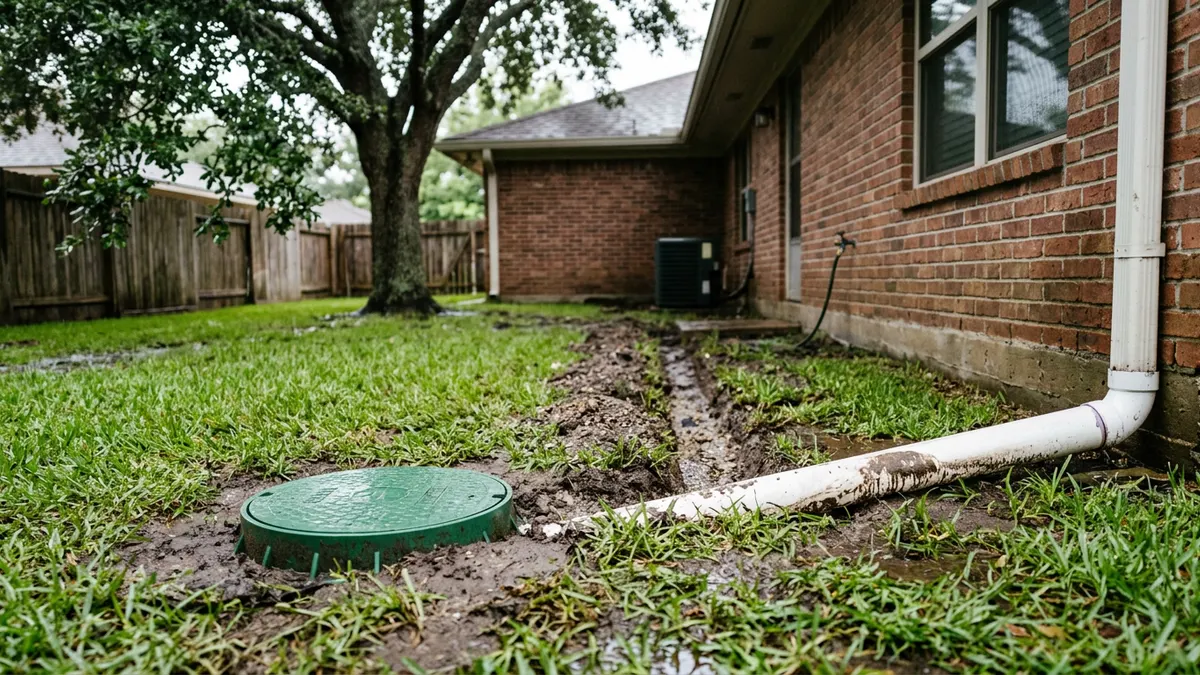
- Puddles below a downspout (the pipe that brings rain down from the gutter), or water collecting against the house.
- Soil washing away in small channels, or water coming from a neighbor's higher lot.
Which drainage system does your yard need?
Match the fix to the problem: a catch basin handles one low spot, and a French drain handles a long wet strip. Regrading handles ground that slopes the wrong way, and a pump handles a flat lot with no outlet (the place where the water leaves).
| What you see | Usual fix |
|---|---|
| One low spot with a puddle in the middle | A catch basin or a pit with a pump - see a catch basin or yard sump pump |
| A long wet strip along a fence, patio or house wall | A French drain - see how a French drain is installed |
| A yard that slopes toward the house | Regrading or a swale - see regrading a yard that slopes the wrong way |
| Roof water dumped onto the lawn | Downspout lines, often into a catch basin |
| A flat lot with nowhere lower to send water | A pit with a sump pump that lifts the water out |
A swale (a wide, shallow dip in the ground that carries water) is the gentle version of regrading.
If the ground slopes the wrong way, a drain will not fix the cause, because the shape of the ground has to change first.
How is a yard drainage system built in Houston clay?
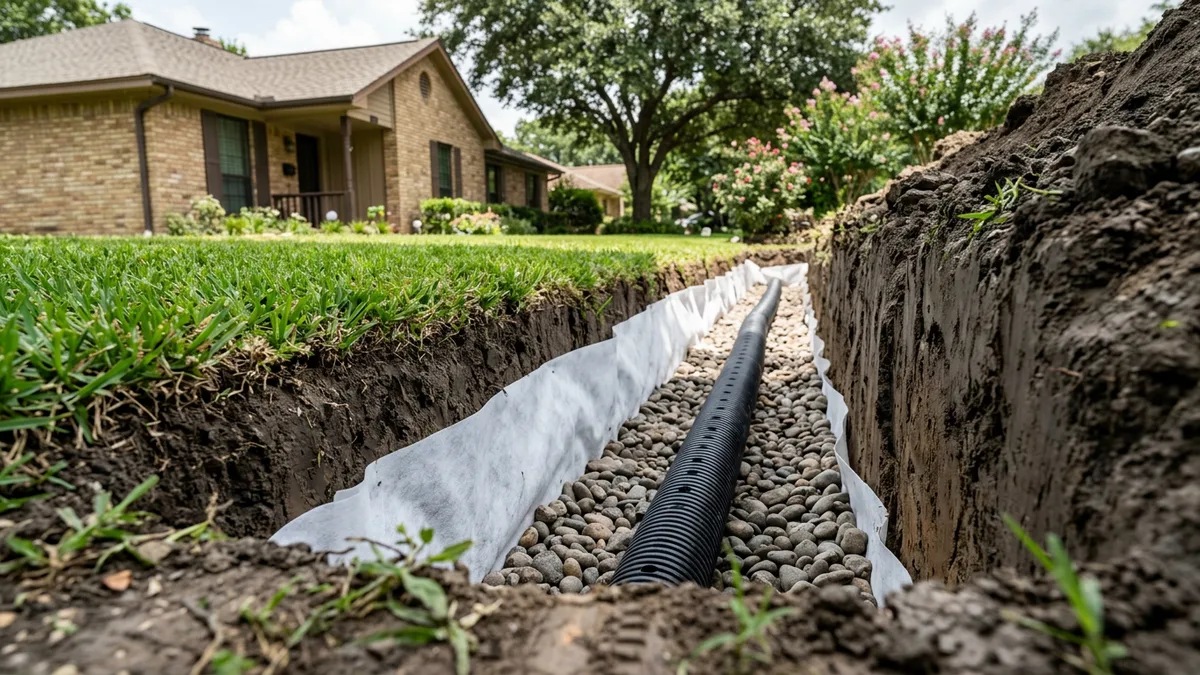
A yard drain is built in five steps. The crew finds the downhill slope (how much the ground drops), digs the trench, lines it with fabric, lays pipe in clean rock and connects an outlet. In Houston clay, the depth and the outlet decide whether the drain works for years.
- Plan. A call to 811 (the free number that gets buried utility lines marked) comes first. The downhill slope and the outlet are found before digging.
- Dig deep enough. In clay, the trench often goes more than 2 feet deep. In sandy soil, 12 to 18 inches is common.
- Line the trench. Filter fabric (a cloth that lets water in but keeps soil out) lines the trench, not just the pipe.
- Pipe and rock. A 4-inch perforated pipe (a pipe with small holes) sits in clean, washed rock, because pea gravel and dirty rock pack down into mud.
- Outlet and finish. The pipe runs to its outlet, long drains get cleanouts (capped pipes for flushing the line), and the lawn is fixed.
The slope is the part that is easiest to get wrong. A 1 percent slope means the pipe drops 1 inch for every 8 feet of its length. A 2 percent slope means it drops a quarter inch for every foot.
| Pipe length | Drop at 1% | Drop at 2% |
|---|---|---|
| 25 ft | about 3 in | about 6 in |
| 50 ft | about 6 in | about 12 in |
| 100 ft | 12 in | 24 in |
Worked out from the 1-inch-per-8-feet rule, not measured on a site. A 100-foot pipe at 2 percent needs 24 inches of drop, and a nearly level yard may not have that much.
Pipe size matters less than people think: a smooth 4-inch plastic pipe on a 1 percent slope carries about 100 to 125 gallons a minute.
Where does the water actually go?
Every yard drain needs an outlet, and on a flat lot the outlet is the hard part. On Houston clay a dry well (an underground pit filled with stone) often fails, so the choice is usually between letting the water flow downhill and lifting it with a pump.
- Downhill outlet. This is the simplest answer when there is somewhere lower to send the water, such as a street, ditch or drain grate, but the pipe needs a downhill slope along its whole length.
- Dry well. The water seeps away underground. It only suits soil where a test hole (a hole filled with water to see how fast it drains) empties in about 4 hours. On most Houston clay that takes far longer.
- Sump pump. A pit with a pump empties itself after each storm and costs about $750 to $1,800 installed.
A good estimate looks at the slope, the soil and the nearest outlet, and says which one your lot needs.
What does yard drainage cost in Houston?
Yard drainage costs depend on the system and the length. Based on several national price guides, a catch basin costs about $500 to $2,500 installed. Regrading costs about $700 to $4,500, more for a big yard. A 100-foot French drain usually costs $1,500 to $8,000.
These are national ranges, not a survey of Houston prices. Length, depth, the outlet and lawn repair change a quote more than the neighborhood does. For a line-by-line breakdown, see what a drain like this costs here.
Already have a drain that is not working?
A soggy yard with a drain already in it usually needs a repair, not a new drain. Common causes are a clogged pipe, fabric full of silt (tiny bits of soil that wash in and block it), a buried outlet, or downspouts connected to the drain line. Fixing the blocked section often costs less than starting over. See fixing a drain that has stopped working.
Yard and lawn drainage covers Houston and nearby towns such as Pearland, League City and The Woodlands, and every job starts with a look at your lot.
Getting an Accurate Quote for Yard Drainage in Houston
Call the number above or fill in the form below to get a free quote with no obligation.
FAQ
Disclaimer: The information on this page is for general information only. It should not be taken or relied on as engineering, construction, legal, financial or other advice. It is based on information that was publicly available at the time of writing, and it may have changed since. It may be inaccurate or incomplete. Always consult a professional. You use this information at your own responsibility and risk, and we take no responsibility for it.
Some content may be written with AI and then reviewed by a person.