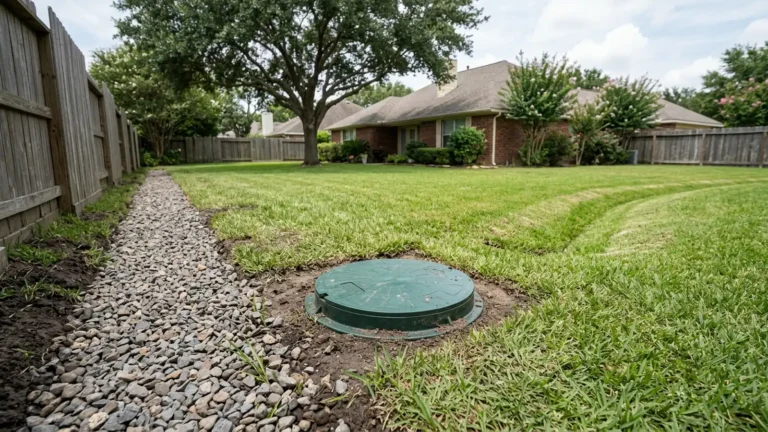
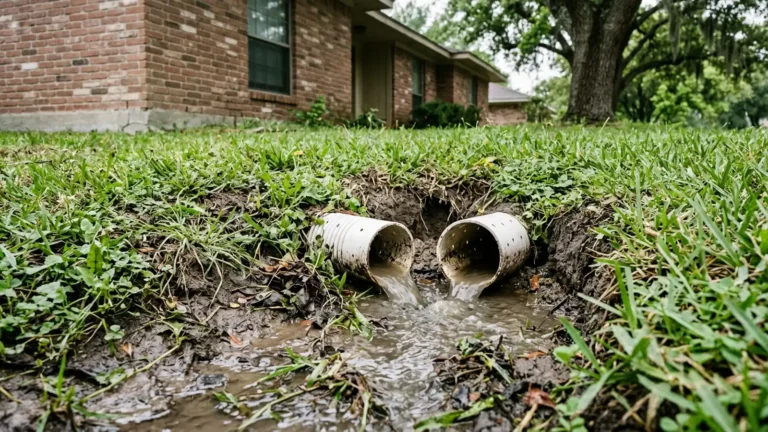
Clay drain trench - ai picture
A French drain (a trench filled with gravel, with a pipe at the bottom) gives water an easier path than the soil around it. Water soaks into the gravel, runs into the pipe and flows downhill to a safe place. In Houston clay, the hard part is getting water out of the packed soil and into the trench at all.
This guide explains each part of that path, using official soil and rain data for Houston. If you already know you need one, see French drain installation built for Houston clay.
What does a French drain actually do?
A French drain does not pull water out of the ground. It works because water always takes the easiest way downhill. Gravel and an open pipe let water move far faster than packed soil. So water near the trench moves into the trench and is carried away.
Most French drains share the same basic parts. A trench is dug with a steady slope down toward the low end. Filter fabric (a cloth that lets water in but keeps soil out) lines the trench. Clean, washed gravel goes in next, with a perforated pipe (plastic pipe with rows of small holes) set inside it. The far end of the pipe reaches an outlet (the place where the water finally comes out).
Each part has one job. The gravel holds the trench open and gives water space to gather. The pipe carries the water away much faster than gravel alone could. Without a working outlet, the trench simply fills up and the yard stays wet.
Why does water behave differently in Houston clay?
Most of Houston sits on heavy clay that lets water through very slowly once it is wet. The same clay cracks open in dry weather and takes in water quickly. So a drain here works in two quite different ways across the year, and it has to be built for both.
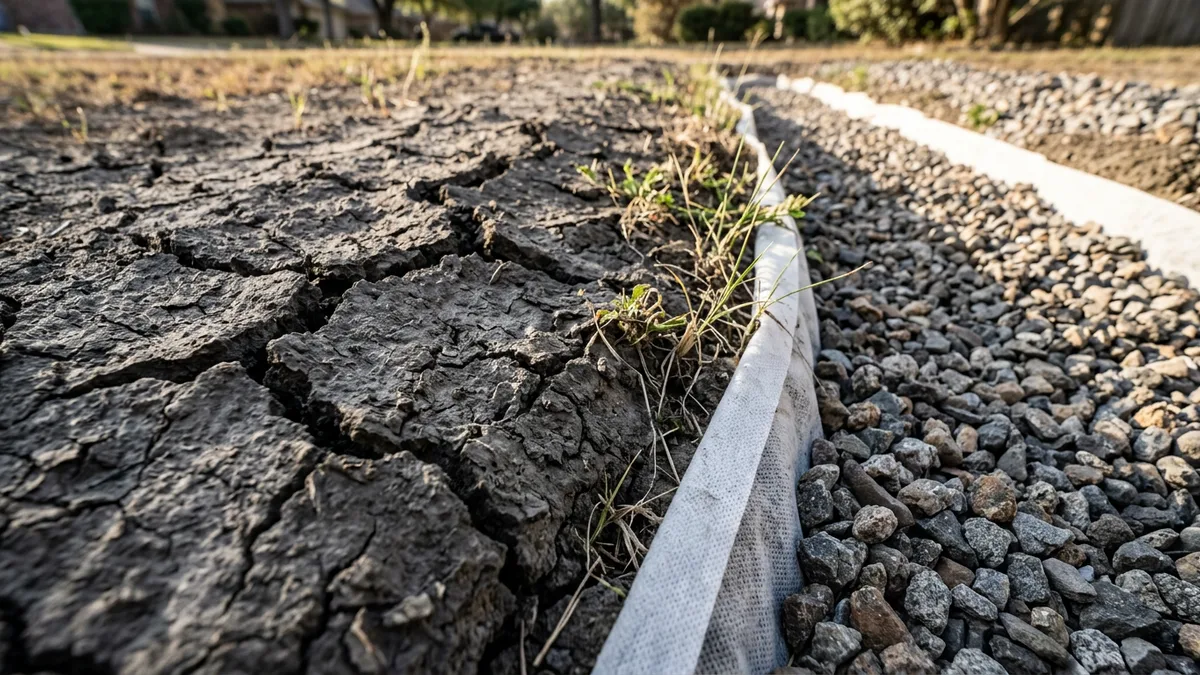
The USDA describes the Lake Charles clay found across much of the city in plain terms. In its official soil description, water moves through this soil very slowly. When the soil is dry, cracks from half an inch to 2 inches wide open at the surface and run a foot or more down. In most years they stay open for 60 to 90 days in total.
That gives a drain two lives. After a dry spell, the first rain pours into the cracks and reaches the trench fast. Once the clay is soaked, the cracks swell and close up, and very little water seeps sideways through the soil. Then most of what reaches a French drain arrives from the surface.
The USDA also rates runoff on this soil as high on nearly flat ground (slopes of 0 to 1 percent), which describes most Houston yards. Rain that cannot sink in spreads across a flat yard and sits in low spots. A drain built for this ground catches that surface water as well as the water inside the soil.
How does water get from the clay into the pipe?
Gravel should run close to the surface, because water takes the most open path down to the pipe. Water soaks down through the gravel, collects in the bottom of the trench and enters the pipe through its holes. In wet clay, that open path from the top is often the only one left.
A common mistake is to fill the top of the trench with the clay that came out of it. That clay soon packs down and seals the trench from the surface. In Houston, where most water arrives from above once the ground is wet, a sealed top can leave a drain doing very little.
The fabric does a quieter job that decides how long the drain lasts. Clay is made of very fine particles, and moving water carries them along. Without a good fabric wrap, the particles settle between the stones and turn clean gravel into sludge over time.
The gravel itself should be clean, rounded stone with large gaps between the pieces. Gravel that holds dust or many small chips packs tightly and leaves little room for water.
How much water can a French drain carry?
A smooth 4-inch pipe at a 1 percent slope can carry about 110 gallons a minute. That is more than most people expect. A 6-inch pipe is used where a lot of water collects. Slope sets the speed, and at least 1 percent (1 inch of drop for every 8 feet) is the normal minimum.
These figures come from a standard engineering formula for pipes running full (completely filled with water). A 6-inch pipe at the same slope carries about 330 gallons a minute. Published figures for the same pipe vary, so these are rounded. Builders' guides put corrugated (ribbed, flexible) pipe at about 20 to 25 percent less.
Here is what that means for a Houston roof. By simple arithmetic, one inch of rain on 1,000 square feet of roof is about 623 gallons. A 4-inch pipe at full flow could move that in under 6 minutes. NOAA (the US weather agency) has rainfall estimates. They put a 10-year storm (a storm with a 1 in 10 chance each year) at 8.74 inches in 24 hours downtown. That is about 5,400 gallons from the same roof.
So the pipe itself is seldom what holds the water back. The real limits are how fast water can get out of the clay and into the gravel, and whether the outlet can take it. That is why a good installer spends more time on the outlet than on the pipe size.
Where does the drained water finally go?
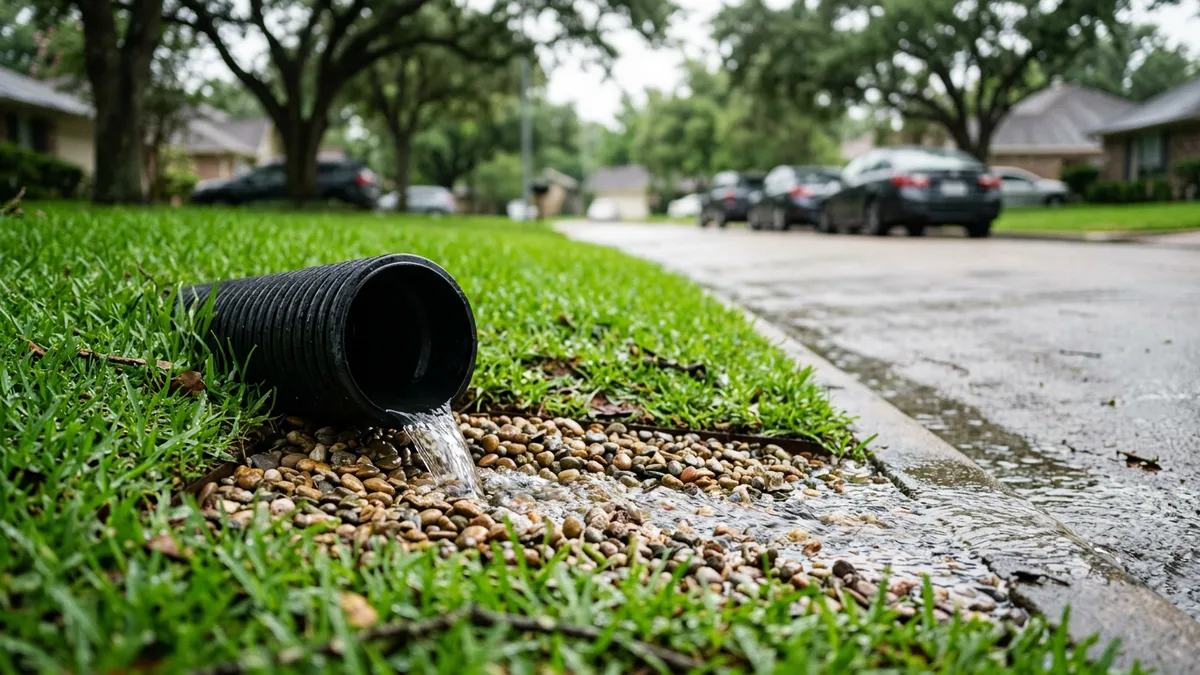
Every French drain ends at an outlet, and that end decides whether the whole system works. On sloped ground, the pipe simply comes out at a lower spot. On a flat Houston yard, the water may need to reach the street, a buried pit or a small pump.
Some lines connect to the City storm sewer (the pipes under the street that carry rain away). For those, the City lists a Storm Sewer Permit at $128.81. Many drains instead end at open ground lower than the trench, or at the curb. In slow-draining clay, a buried pit fills fast and empties slowly, so a pump is often the only choice on dead-flat ground.
FAQ
Disclaimer: The information on this page is for general information only. It should not be taken or relied on as engineering, construction, legal, financial or other advice. It is based on information that was publicly available at the time of writing, and it may have changed since. It may be inaccurate or incomplete. Always consult a professional. You use this information at your own responsibility and risk, and we take no responsibility for it.
Some content may be written with AI and then reviewed by a person.