
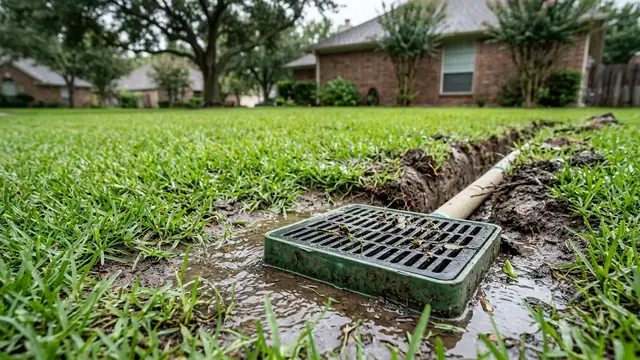
Lawn catch basin - ai picture
Rain water that pools in one place needs a way out. A catch basin (a box in the ground with a grate on top) collects it at one low spot. A channel drain (a long, narrow drain with a grate on top) catches it along a line, often across concrete. Both send the water through a pipe to an outlet (the place where the water leaves).
The estimate is free, and you do not have to hire anyone.
Why do Houston yards need surface drains?
Houston rain often falls faster than flat clay can take it. NOAA (the US weather agency) has rainfall estimates for Houston. In a 100-year storm (a storm with a 1 in 100 chance each year), downtown Houston gets 17.0 inches in 24 hours. Water that cannot soak in runs to the lowest point, and a surface drain gives it an exit.
A 20 by 20 foot driveway collects about 250 gallons for each inch of rain. A 17-inch storm puts about 4,200 gallons on that driveway. That is simple arithmetic from the NOAA depth, not a measurement of any yard.
A lawn sends off less water, but most of Houston sits on expansive clay (clay that swells when wet and shrinks as it dries). Wet clay swells and closes up, so a low spot can stay wet for days.
What is the difference between a catch basin, a channel drain and a trench drain?
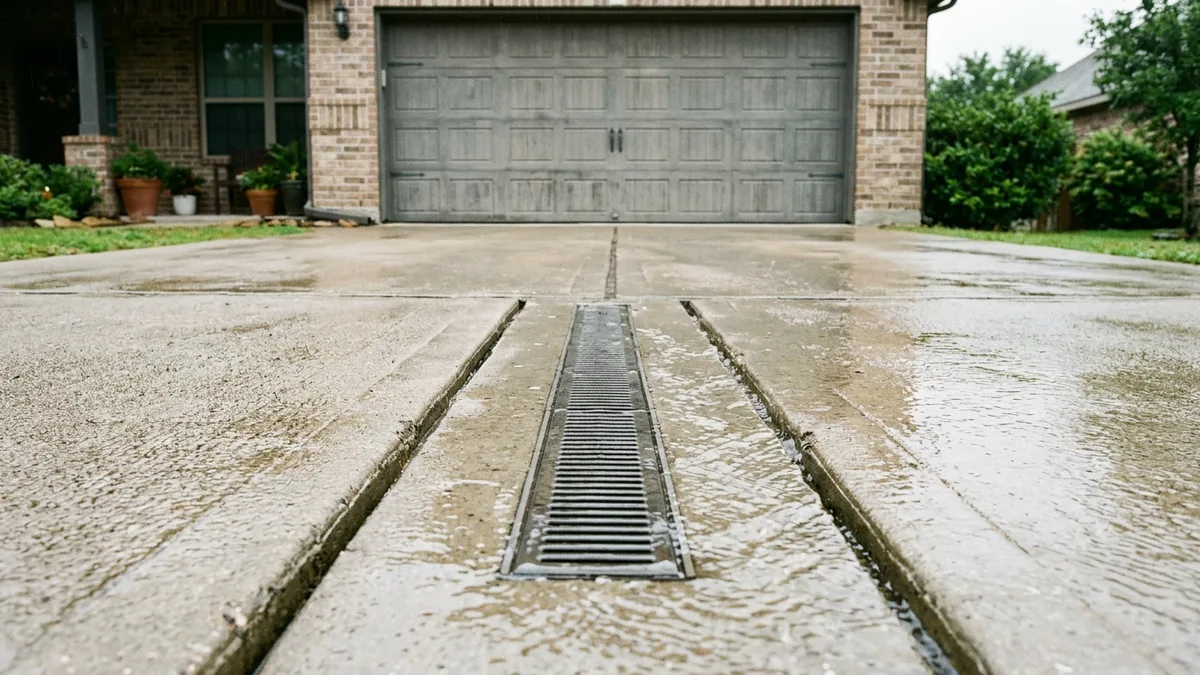
A catch basin serves one low spot, such as a puddle in the lawn. A channel drain serves a line, such as the front of a garage. A trench drain (another name for a channel drain, often a heavier one) works the same way.
| Inlet | Where it goes | What it is good at |
|---|---|---|
| Catch basin | The low point of a lawn, bed or patio corner | One clear puddle; it has a built-in dirt trap |
| Channel or trench drain | Across a driveway, along a pool deck or patio edge | A sheet of water moving across a hard surface |
Both end in a solid pipe, and the pipe still needs an outlet. If the ground is wet along a long strip, not at one point, the water is moving through the soil. A French drain (a trench filled with gravel, with a pipe at the bottom) collects it under the ground. So a French drain system is the better tool. For a lawn that stays soggy everywhere, see drainage for a wet lawn.
How is a catch basin installed?
A catch basin goes in at the lowest point. It sits a little below the lawn so water runs in, and a sloped solid pipe (pipe with no holes) drains it to an outlet. A grit trap (a small chamber that catches dirt) sits under the pipe opening. It keeps silt (tiny bits of soil that wash in and block it) out of the line.
- Mark lines and find the low point. Call 811 (the free number that gets buried utility lines marked), then check where the water really stops after rain.
- Set the outlet first. The outlet height decides how deep the basin and pipe can sit.
- Dig the hole and set the box. The box sits on a packed base, with its grate just under the finished lawn.
- Lay solid pipe on a slope. A 1 percent slope means the pipe drops 1 inch for every 8 feet. On a flat yard, that drop is hard to find.
- Connect, fill and test. The pipe is joined to the outlet and the trench is filled and covered with sod (rolls of ready-grown grass). Then the system is tested with a hose.
A downspout (the pipe that brings rain down from the roof) should run into a catch basin, not into a pipe with holes. The basin then traps the roof grit (loose gritty bits from the shingles). See downspout drainage.
Where does a channel drain go in front of a garage?
A channel drain goes across the driveway just in front of the garage door, so the water stops short of the door. Fitting it into an old driveway is covered on the page about driveway and patio drainage. So is fixing the strip in front of the door that slopes toward it (the apron).
How does pool deck drainage work?
A pool deck slopes away from the pool, toward a deck drain or the deck edge. Deck slopes are small, often about 1 to 2 percent, which is 1/8 to 1/4 inch per foot.
On a flat Houston yard, the deck edge often sits only a few inches above the ground. So the water stops at the edge and soaks the clay beside the deck. The usual fix is a channel drain along the low edge of the deck. The drain is piped to a catch basin or a pit with a pump. It can also go to a pop-up emitter (a small cap in the lawn that opens to let water out).
What if the lot is too flat for the water to flow away?
On a very flat yard, the water needs another way out than flowing downhill. A yard sump pump (a pump that pushes water out when it cannot flow downhill) is the most common answer. It sits in a pit (a hole dug at the low corner). It pushes the water to the curb or a lower part of the yard.
A dry well (an underground pit filled with stone) is another way to get rid of water without slope. But the soil has to drain well for it to work. An installer checks with a test hole (a hole filled with water to see how fast it drains). If it takes more than 4 hours to empty, the soil is not suitable, and many Houston clay yards may fail. A swale (a shallow, grassy ditch that carries water) is a third option. See dry wells, swales and French drains compared.
Can the water go into the city storm sewer?
Sometimes, with a permit. The storm sewer (the pipes under the street that carry rain away) belongs to the City. Currently the City lists a Storm Sewer Permit at $128.81 to connect from private property. It also lists a catch basin or outside area drain permit, which a registered master plumber (the top plumbing license) applies for. That one costs at least $97.56, plus a $33.56 administration fee (a charge for handling the paperwork).
Many jobs need neither permit, because the pipe ends at the curb or in the yard. At the site visit, the installer checks which route fits your yard.
What do catch basins and channel drains cost?
Based on several national cost guides, an installed catch basin costs about $500 to $2,500. A channel drain costs about $30 to $125 per foot, plus cutting and patching the concrete. The concrete work often costs more than the channel itself. These are national figures, not a survey of Houston prices.
A good quote (a written price) lists the outlet, concrete patching, soil removal and lawn repair. For line-by-line numbers, see what a drainage system costs here.
Catch basins and channel drains are installed in Houston and nearby towns such as Pearland, League City and The Woodlands.
Getting an Accurate Quote for Channel Drain Installation in Houston
Call the number above or fill in the form below to get a free quote with no obligation.
FAQ
Disclaimer: The information on this page is for general information only. It should not be taken or relied on as engineering, construction, legal, financial or other advice. It is based on information that was publicly available at the time of writing, and it may have changed since. It may be inaccurate or incomplete. Always consult a professional. You use this information at your own responsibility and risk, and we take no responsibility for it.
Some content may be written with AI and then reviewed by a person.