

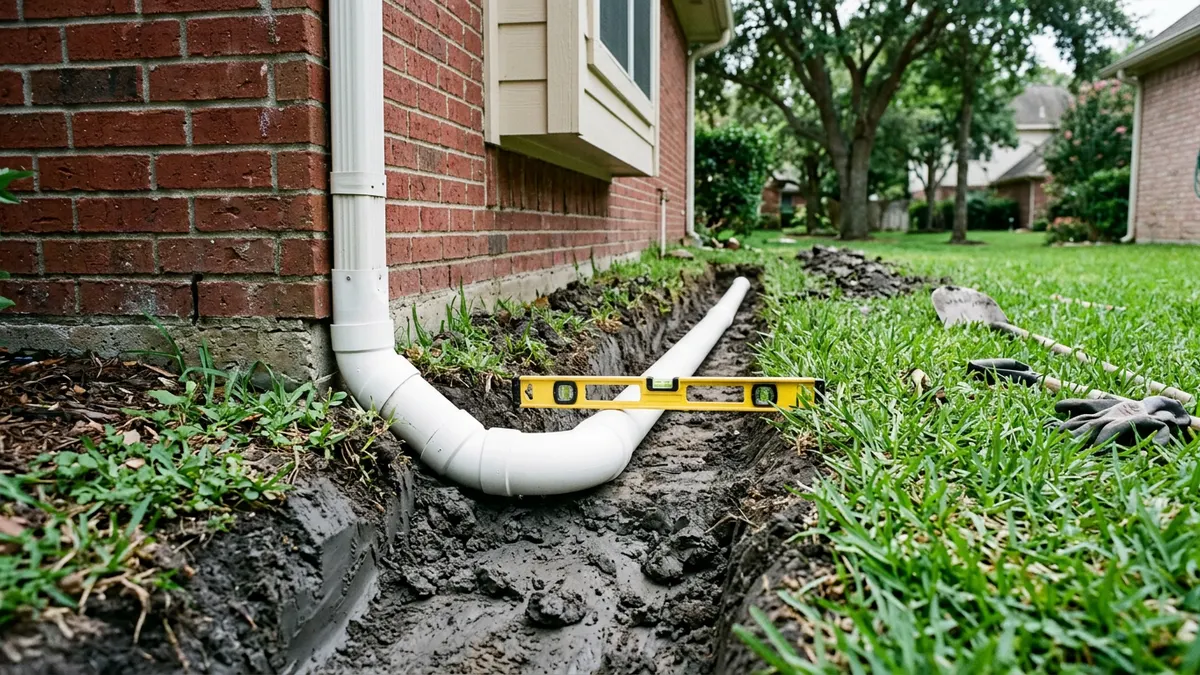
Buried downspout drain - ai picture
Downspouts (the pipes that bring rain down from the roof gutters) often drop water right next to the slab (the concrete base of the house). On Houston clay, that water soaks in along the foundation, so downspout drainage moves it away from the house. The usual fix is a buried solid pipe from each downspout to a lower spot in the yard or the curb. The pipe slopes downhill so it empties after every storm.
The estimate is free, and you do not have to hire anyone. The installer starts by finding where the water from each downspout goes now.
How much water comes off a Houston roof?
Each square foot of roof sends off about 0.62 gallons for every inch of rain. So 1,000 square feet of roof sends about 620 gallons into the gutters per inch. The gutters gather all of it into a few downspouts. Each one drops its share on a patch of ground a foot or two wide.
| Roof area served | One inch of rain | 10-year storm (8.74 in) |
|---|---|---|
| 500 sq ft | about 310 gallons | about 2,700 gallons |
| 1,000 sq ft | about 620 gallons | about 5,400 gallons |
| 2,000 sq ft | about 1,250 gallons | about 10,900 gallons |
Simple arithmetic, using the Atlas 14 rainfall estimates from NOAA (the US weather agency). A 10-year storm has a 1 in 10 chance each year, and this one drops 8.74 inches in 24 hours in downtown Houston.
In an average year, Bush Intercontinental Airport gets 51.84 inches of rain (the 1991-2020 average). That puts about 32,000 gallons on a 1,000 square foot roof, which is a lot of water to let out beside a slab.
Why does downspout water matter on Houston clay?
Houston clay swells when it gets wet and shrinks as it dries. Water dumped at a downspout wets one spot much more than the rest of the slab edge. Uneven wetting is bad next to a foundation.
Soil experts at the US Department of Agriculture say the local clays shrink and swell a great deal. The City of Houston's emergency office says this clay can swell by a tenth or more of its dry size when wet.
Signs that downspouts are the cause:
- A puddle or a washed-out hollow at the foot of a downspout after each rain.
- Flower beds along the house that stay soggy, or soil that pulls away from the slab in dry spells.
- A soggy lawn below the downspouts, worst on the side with the most roof.
- Water sitting against the slab or running toward a neighbor's yard.
If the water already reaches the foundation, see what can be done about water sitting against the foundation.
Is an extension enough, or do you need a buried line?
An extension (a pipe that carries water farther from the downspout) above the ground is fine if it is not in the way. The land must also slope away from the house. A buried line is better when the yard is flat, an extension is in the way, or the water must travel far.
Many guides suggest letting water out at least 5 feet from the house, and 10 feet or more for a buried pipe. On flat Houston yards, the ground next to the slab should also drop about 6 inches over the first 10 feet. If not, the water drifts back toward the house.
How is an underground downspout drain built?
A buried downspout drain is a solid pipe, without holes. The pipe starts at an adapter (a fitting that joins it to the downspout). It runs on a steady downhill slope to an outlet (the place where the water comes out). Solid pipe keeps the roof water inside until it is well away from the slab. The ground rarely freezes deep in Houston, so the slope, not frost, sets how deep the pipe goes.
- Mark buried lines, then pick the route: A free call to 811 gets buried utility lines marked. The outlet is chosen first, because its height sets the slope of the whole pipe.
- Dig on a slope: A 1 percent slope means the pipe drops one inch for every 8 feet. So a 30-foot pipe needs almost 4 inches of drop.
- Lay smooth solid pipe: A 4-inch smooth pipe is the usual size. National guides say corrugated pipe (bendy pipe with ridges) carries about 20 to 25 percent less water than smooth pipe. Its ridges also catch roof grit (loose gritty bits from the shingles).
- Add a filter: A leaf filter at the downspout keeps roof grit out. So does a cleanout (a capped pipe that opens so the line can be cleaned).
- Set the outlet and test it: The outlet goes in, and the trench is filled and covered with sod (rolls of ready-grown grass). Running a hose down the downspout shows that the water flows out at the end, which proves the slope.
Avoid feeding a downspout into a French drain (a trench filled with gravel, with a pipe at the bottom). Its perforated pipe (plastic pipe with small holes) lets roof grit into the gravel and plug it. A sudden burst of roof water can also push out of the holes right beside the house. In a yard with both a downspout line and a French drain, roof water first runs through a solid pipe and a box that traps grit. Only then can it join the French drain for the rest of the way.
Where should the water from a downspout go?
The water should end up lower than the downspout and away from the house. It should also stay away from the neighbor's yard and anything it can wash away. On a flat yard the outlet decides the design more than the pipe does.

- Pop-up emitter (a small cap in the lawn that opens to let water out): It spreads the water over the grass. It needs a spot lower than the start of the line.
- Catch basin (a box in the ground with a grate on top): It collects water from one or more downspouts and holds back grit. See catch basins and channel drains (channel drains are long, narrow drains with a grate on top).
- Curb or street outlet: Common on front yards that slope toward the street.
- A pump in a pit. Where there is no lower ground, a small sump pump (a pump that pushes water out when it cannot flow downhill) in a pit lifts the water out.
Joining a downspout to a drainage system is where a City permit can come in. As of this writing, the City of Houston's permit list includes a roof drain or outside downspout permit for this. A master plumber (the top plumbing license) or a drain layer (a drain pipe installer) registered with the City gets the permit. The fee is $34.24 for the first two downspouts and $11.41 for each extra one, with a minimum of $97.56. A $33.56 administration fee is added on top.
What does downspout drainage cost?
As a rough estimate based on national figures, one buried line of about 30 feet costs about $250 to $950. It includes about $30 to $75 of solid pipe, plus a few connectors and an emitter. Digging takes 4 to 7.5 hours in clay, at a labor cost of $45 to $110 an hour.
This is an estimate from national prices, not a Houston quote. Several downspouts sharing one trench cost less each. Cutting through concrete, or adding a catch basin or a pump at the outlet, adds to the price. For the full price list, see downspout and drainage pricing.
Roof-water drains for downspouts and gutters are built in Houston and nearby towns such as Pearland, League City and The Woodlands.
Getting an Accurate Quote for Downspout Drainage in Houston
Call the number above or fill in the form below to get a free quote with no obligation.
FAQ
Disclaimer: The information on this page is for general information only. It should not be taken or relied on as engineering, construction, legal, financial or other advice. It is based on information that was publicly available at the time of writing, and it may have changed since. It may be inaccurate or incomplete. Always consult a professional. You use this information at your own responsibility and risk, and we take no responsibility for it.
Some content may be written with AI and then reviewed by a person.