
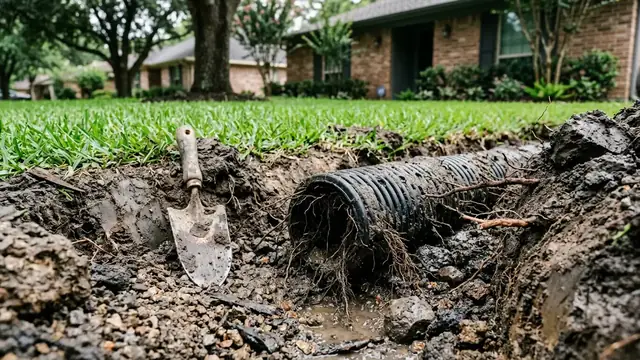
Clogged French drain - ai picture
A French drain (a trench filled with gravel, with a pipe at the bottom) can slowly stop working. Drainage repair in Houston usually means finding the one part that has failed and fixing only that part. Most problems sit at the outlet (the place where the water leaves the drain). Others are in a stretch of pipe full of silt (tiny bits of soil that block it). Some are where a downspout (the pipe that brings rain down from the roof) is connected to the drain. The estimate is free and starts with finding the part that has failed.
Why do drains fail sooner in Houston?
Houston is hard on drains for three reasons. First, the clay soil washes silt into the pipe. Second, the rain comes in heavy bursts (a lot of rain in a short time). Third, the land is flat, so the outlet is only a little lower than the pipe.
Most of Houston sits on gumbo (heavy, sticky clay). The US Department of Agriculture's soil descriptions call it the Lake Charles and Beaumont soils. Water seeping through this clay carries silt. Thin or torn fabric cannot hold it back, so the silt slowly fills the rock and the pipe.
NOAA (the US weather agency) publishes rainfall tables called Atlas 14. In downtown Houston, a 10-year storm (a 1 in 10 chance each year) drops 8.74 inches in 24 hours. That much rain quickly overwhelms a half-blocked pipe.
Around Cypress and Tomball the soil is sandier, so check the outlet and slope of a slow drain there first.
How can you tell your drain has stopped working?
A failing drain shows signs in the places it used to keep dry. Water comes back to the old wet spot, the outlet stays dry during rain, or a soft, sunken strip appears along the pipe.
- The lawn over the drain stays soggy while the rest of the yard dries.
- The outlet, or the pop-up emitter (a small cap in the lawn that opens to let water out), does not flow in heavy rain.
- Water bubbles up out of a catch basin (a box in the ground with a grate on top) instead of draining into it.
For a longer checklist, read the guide to signs a French drain is clogged or failing.
What usually breaks inside a failing drain?
Most failures come from a few build mistakes and worn parts, and the repair depends on which one it is.
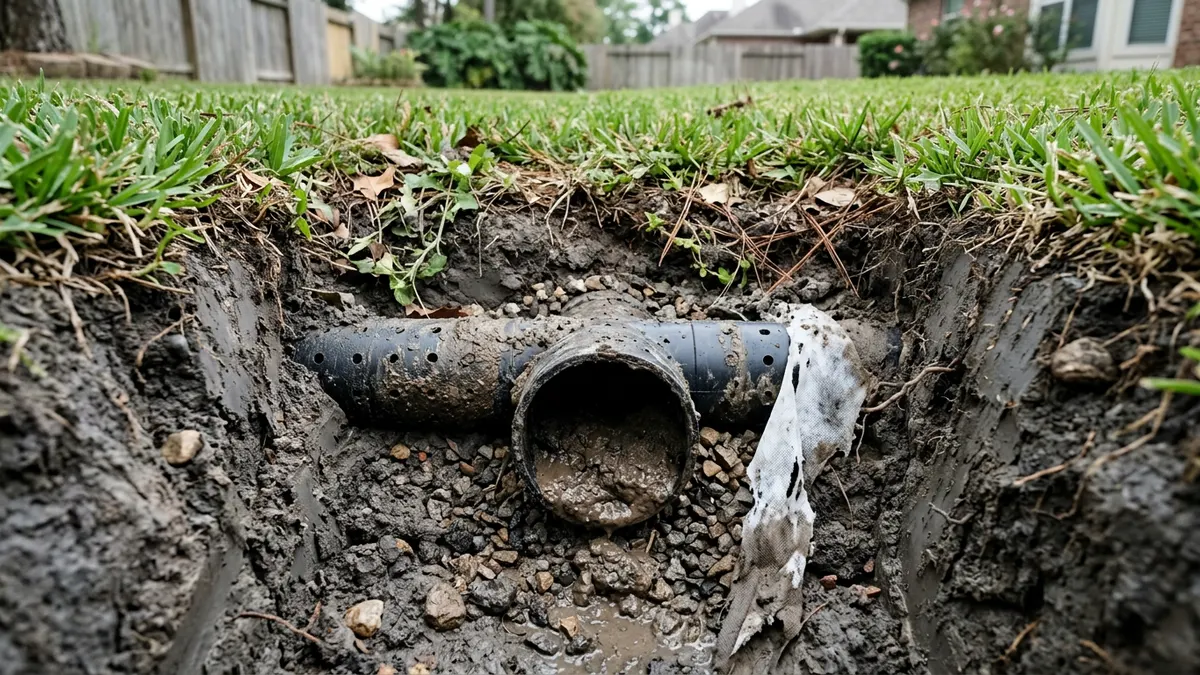
- An outlet that is covered or blocked. Mulch, sod (rolls of ready-grown grass) or a new patio covers the exit, so the water has nowhere to go.
- Silt in the fabric and rock: Thin fabric, or none at all, lets silt clog the rock. Dirty rock or pea gravel (small, round stones that pack down) does the same from day one.
- Downspouts connected to the drain pipe: The drain uses perforated pipe (plastic pipe with small holes). Roof grit (loose gritty bits from the shingles) and leaves go straight into those holes, so roof water needs its own pipe with no holes.
- Low dips along the pipe: A low spot in the pipe holds water and collects silt until the pipe is blocked.
- Roots: Trees find the water and grow into the holes.
A sump pump (a pump that pushes water out when it cannot flow downhill) often lasts about ten years. A dry well (an underground pit filled with stone) that fills with silt stops taking water. Both are covered on the page about catch basins and yard sump pumps.
How is the problem found and fixed?
The work starts at the outlet, the cheapest place to look, and moves back along the line. The line is opened only where it has failed, and rebuilding that part properly for clay fixes the real cause.
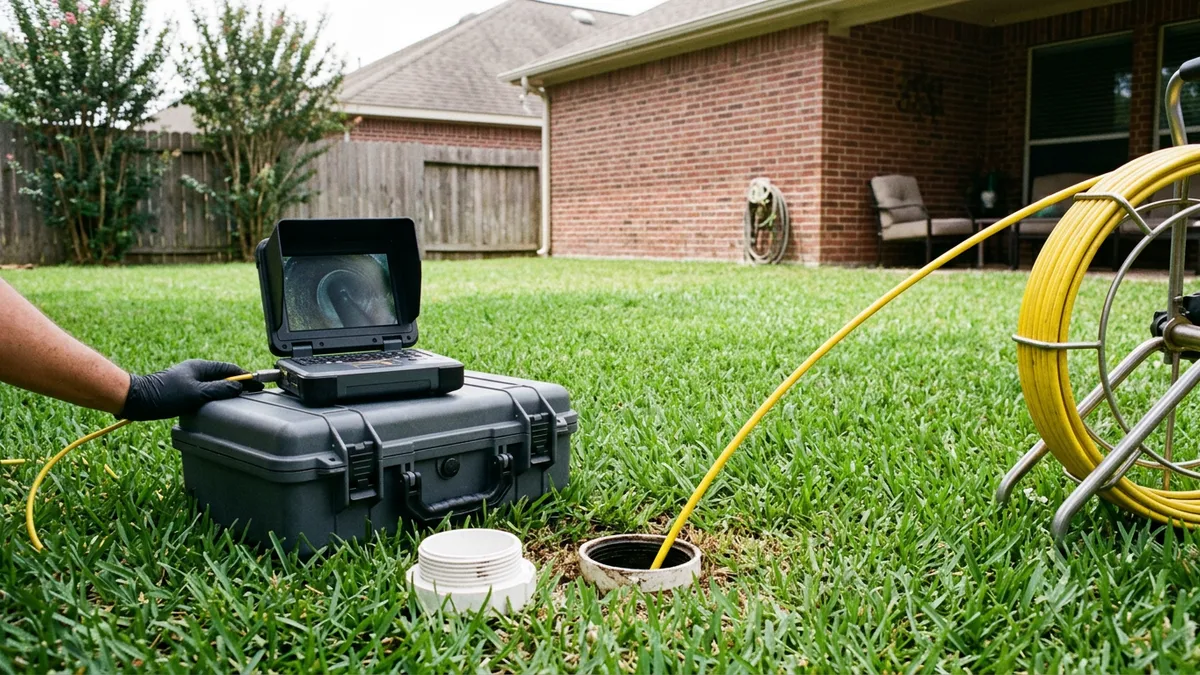
- Check the outlet: Uncover it, clear it and make sure it sits lower than the pipe.
- Water test. Run a hose into the cleanout (a capped pipe that gives access to the drain) or the upper end of the pipe. Watch where the water stops or comes up.
- Camera check. A small camera pushed down the pipe shows silt, roots, a crushed pipe or a dip, and where along the pipe each one is.
- Flush a pipe that is not damaged: A strong jet of water flushes out the silt and small roots.
- Rebuild only the broken part. A call to 811 (the free number that gets buried utility lines marked) comes first. Then that part is dug out again, in clay often more than 2 feet deep. It is lined with filter fabric (a cloth that lets water in but keeps soil out). New pipe goes in clean washed rock with the right slope.
- Add a cleanout and fix the lawn: A new access point makes the next flush easy.
Rebuilt parts get PVC (a hard, smooth plastic) pipe. A smooth 4-inch pipe on a 1 percent slope (a drop of 1 inch for every 8 feet) carries about 100 to 125 gallons of water a minute. Corrugated pipe (bendy pipe with ridges) of the same size carries about 20 to 25 percent less.
Repair or replace: which makes sense?
Repair makes sense when the trench was dug deep enough and the problem is in one place. Examples are a blocked outlet, one clogged stretch of pipe, or a crushed joint (where two pipes connect). Replacement makes sense when the whole drain was built wrong, such as a shallow trench, no fabric, or no slope. Fixing one part of a badly built drain only delays the next failure.
Published lifespans for French drains range from 5 to 40 years, mostly depending on how well they were built.
Sometimes a camera and a short test dig show the drain was built for sandier ground. Then the money is better spent on a new French drain installation built for clay.
What does drainage repair cost in Houston?
Repair usually costs less than a new drain, because only part of the line is touched. Based on several national cost guides, drain cleaning costs about $75 to $600 per visit. Rebuilding a failed part is priced per foot, and the outlet or a pump can add to that.
For example, national rates for a drain built deep for clay are about $35 to $80 a foot. At those rates, rebuilding a 20-foot failed part costs about $700 to $1,600. That is an estimate from national rates, not a survey of Houston prices. For full price ranges by length, see what drainage repair costs in Houston.
How do you keep a repaired drain working?
A repaired drain keeps working when water can get in, move along and get out. That means a clear outlet, roof water kept out of the drain pipe, and a way to flush the pipe before it blocks. On drains over 100 feet long, many guides suggest a cleanout every 50 to 75 feet.
Drain repair is available in Houston and nearby towns such as Pearland, League City and The Woodlands.
Getting an Accurate Quote for Drainage Repair in Houston
Call the number above or fill in the form below to get a free quote with no obligation.
FAQ
Disclaimer: The information on this page is for general information only. It should not be taken or relied on as engineering, construction, legal, financial or other advice. It is based on information that was publicly available at the time of writing, and it may have changed since. It may be inaccurate or incomplete. Always consult a professional. You use this information at your own responsibility and risk, and we take no responsibility for it.
Some content may be written with AI and then reviewed by a person.