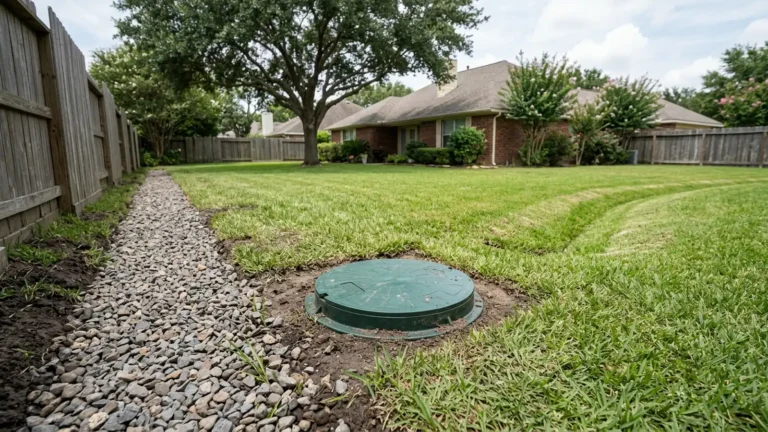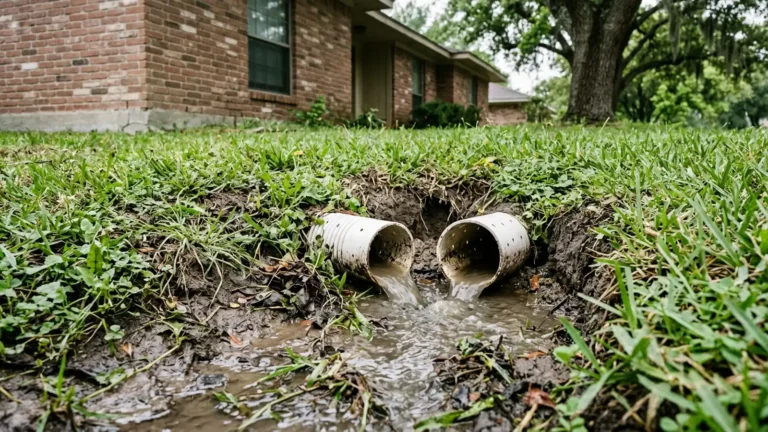
Clogged drain outlet - ai picture
Over time, a French drain (a trench filled with gravel, with a pipe at the bottom) can clog up and stop doing its job. The signs a French drain is clogged or failing are easy to spot. Water comes back to the spot it used to clear. The outlet (the place where the water comes out) stays dry while it rains. Or the ground over the drain turns soft or sinks. Each sign points to a different part of the drain, so reading the signs first saves money on the fix.
If you already see two or more of these signs, a drain check is worth booking before the next big storm.
What are the signs a French drain has stopped working?
The clearest sign is change: the yard used to dry out after rain, and now it does not. A working drain keeps the same strip of ground firm, and its outlet flows during a storm. When either of those stops, something inside the drain has slowed or broken.
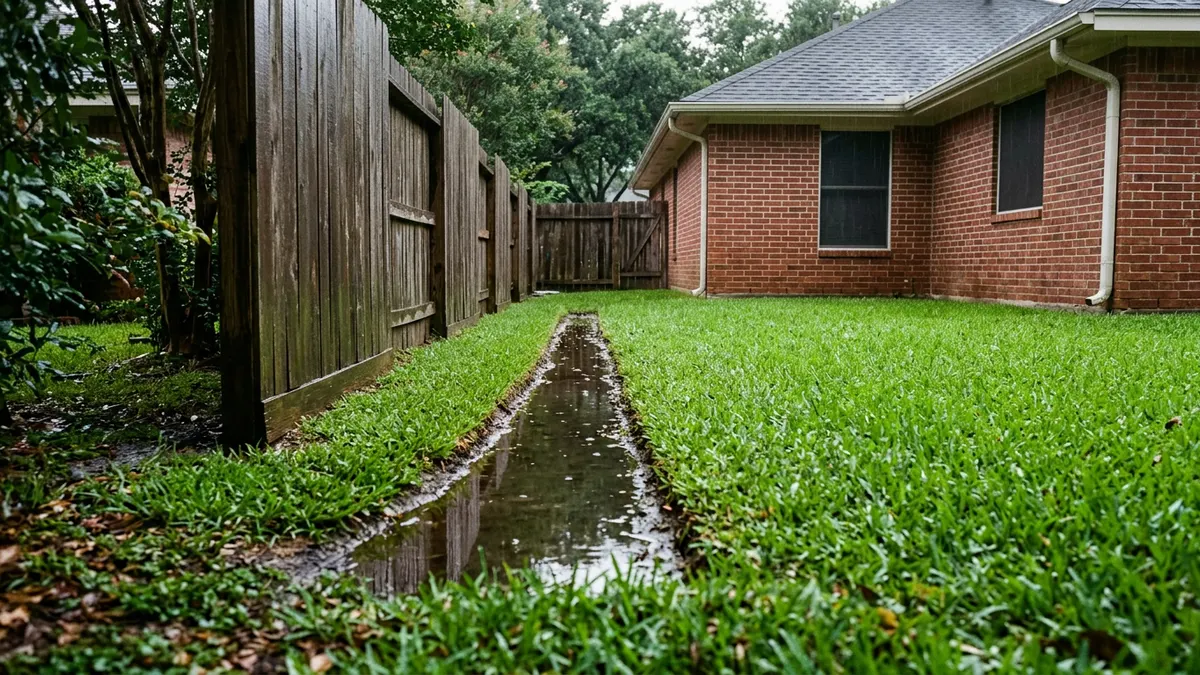
- The old wet spot is back. Puddles return to the patch the drain was built to clear.
- The outlet stays dry in a downpour. No water comes out at the curb or in the yard while the lawn floods.
- A soggy, sagging strip of lawn. The lawn dips or squelches along the path of the pipe.
- Water bubbles up out of the ground or a catch basin (a box in the ground with a grate on top). The water is backing up instead of moving through.
- Water against the house again. Flower beds or the edge of the slab (the concrete base of the house) stay wet where they used to dry.
A big storm is the usual test. NOAA (the US weather agency) says a 10-year storm (1 in 10 chance each year) drops 8.74 inches in 24 hours downtown. A drain slowly filling with silt (tiny bits of soil that wash in and block it) can cope with light rain for years. Then it fails in a heavy one.
What does each sign usually point to?
Each sign tends to lead back to one part of the drain: the outlet, the pipe, the rock and fabric, or what feeds into it. Matching the sign to the part shows where to look, and where to dig, before anyone opens the lawn.
| What you see | What it usually points to |
|---|---|
| Outlet dry while the yard floods | A blockage in the pipe, or a buried or crushed outlet |
| Water bubbling up along the line | A blockage further down the line |
| Sunken strip over the pipe | Soil washing into a broken pipe or a gap in the fabric |
| Whole line slow, no single spot | Silt in the rock and fabric along its length |
| Wet only near a downspout | Roof grit (loose gritty bits from the shingles) washed into the drain pipe |
| Slow at one end near trees | Roots in the pipe |
This is a guide to the most likely cause, not a diagnosis, and a camera or a test dig confirms it. Look beyond the pipe, too. A buried exit or a silted-up catch basin can make a healthy line look blocked.
Why do drains clog faster in Houston clay?
Houston clay carries very fine silt, and thin fabric lets it through. Water seeping toward the drain carries the silt along. Filter fabric (a cloth that lets water in but keeps soil out) can be too thin, torn or missing. Then the silt gets into the rock and the pipe. Over time the rock packs tight and the pipe fills with silt.
The flat land adds a second problem. On a yard with little slope, the outlet sits only just below the pipe. So a little mulch, sod (rolls of ready-grown grass) or a new patio is enough to bury the outlet. A drain with a buried outlet looks clogged even when the pipe is fine.
How is a drain checked for a clog?
A clog is found by running water through the drain and watching where it goes. The installer starts at the outlet and makes sure it is open and lower than the pipe. Then water is fed in at a cleanout (a capped pipe that gives access to the drain). Water at the outlet means the pipe is at least partly open. Water backing up, or coming up in the lawn, shows roughly where the blockage sits, so only that part of the line needs opening. The check is done slowly and from the outlet back, because forcing water or a rod into a blockage can push the clog further in.
If the drain has no cleanout, adding one is often part of the repair, because without it every future check means digging.
How do you stop it clogging again?
Most of what keeps a drain working is simple care around it. Keep the exit uncovered, keep gutter water out of the gravel line and add a cleanout before silt sets hard. None of these steps costs much, and they are what make a repair last.
- Leave the outlet in plain sight: mark it with a stone or a stake, so mulch, sod and new beds do not cover it.
- Walk the line after big storms: a dry outlet or a new soft spot is easier to fix early than late.
- Keep roots in mind: avoid planting thirsty trees and shrubs right on top of the pipe.
- Ask for cleanouts: any repair is a good moment to add one at the upper end. Then the next check needs a hose, not a shovel.
Repair or replace?
Many clogged drains can be repaired, but a drain built wrong for clay (too shallow, no fabric or no slope) usually has to be replaced. The page on drainage repair explains how the choice is made. Prices for both are on the page about what repairs and replacements cost, and a full rebuild means a new French drain built for clay.
Want someone to read the signs for you?
A free assessment tells you whether you need a quick clear, a repair of one part or a rebuild. Call xxx-xxx-xxx or use the form below.
FAQ
Disclaimer: The information on this page is for general information only. It should not be taken or relied on as engineering, construction, legal, financial or other advice. It is based on information that was publicly available at the time of writing, and it may have changed since. It may be inaccurate or incomplete. Always consult a professional. You use this information at your own responsibility and risk, and we take no responsibility for it.
Some content may be written with AI and then reviewed by a person.