
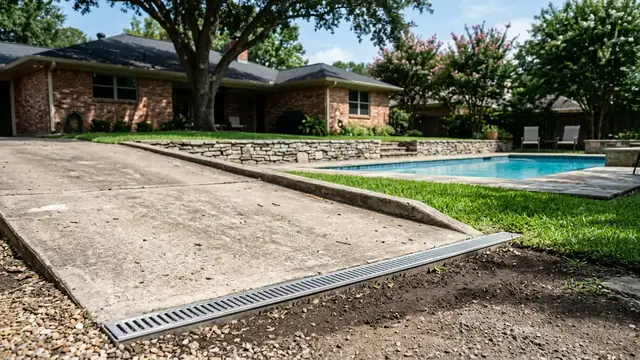
Driveway channel drain - ai picture
Driveway and patio drainage moves rain off the concrete and away from the garage, the house and the edges of the concrete. The usual fix is a channel drain (a long, narrow drain with a grate on top) or a change in slope. Either way, a pipe takes the water to an outlet (the place where it leaves).
The estimate is free, and you do not have to hire anyone.
Why do driveways and patios flood in Houston?
Concrete lets almost no rain soak in, and a flat Houston yard gives the water little room to run off. The ground is expansive clay (clay that swells when wet and shrinks as it dries), which takes water in slowly. NOAA (the US weather agency) has rainfall estimates for Houston. They put a 10-year storm (a storm with a 1 in 10 chance each year) at 8.74 inches in 24 hours.
A two-car driveway of 20 by 20 feet collects about 250 gallons for each inch of rain. In that storm, it sends about 2,200 gallons toward its lowest edge. This is a rough estimate from the NOAA rain depth.
The clay also moves. When the soil beside the concrete dries and shrinks, the edge can drop a little. Over the years, a driveway or patio can end up tilted toward the house.
What are the signs a driveway or patio needs drainage work?
Water that stays, or runs the wrong way, after the rain has stopped is the main sign. Other common signs are:
- water running down the driveway and under the garage door
- a puddle on the patio next to the back door that stays for hours
- mulch or soil from the flower beds washed across the concrete
- soil along the edge of the concrete washed out, or an edge that has dropped
Rain from the roof often makes the problem worse. When downspouts (the pipes that bring rain down from the gutters) empty onto a driveway or patio, the concrete carries the roof water too. The downspout part is fixed with drainage for the downspouts.
How do you stop water running into the garage?
A channel drain across the driveway, just in front of the garage door, catches the water before it reaches the door.
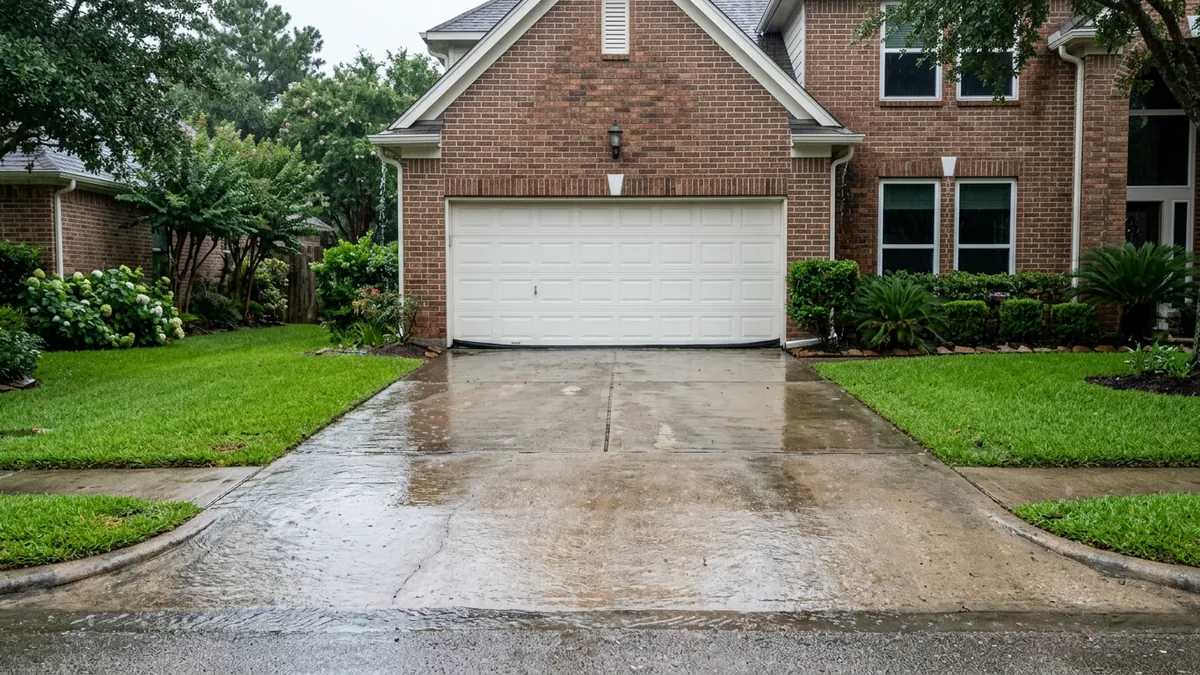
The drain sits at the low point, with its grate level with the concrete, and a solid pipe (pipe with no holes) carries the water to an outlet. On an existing driveway, the drain goes into a narrow saw cut, and the rest of the concrete stays in place. That is why most driveway drains can be added to old concrete.
Sometimes the apron (the strip of driveway right in front of the garage door) is the real problem, because it slopes toward the door. Then that strip may need to be rebuilt with the right slope, with or without a drain. The installer checks the slope with a level before giving you a price. A driveway grate also has to be strong enough to carry the weight of cars and trucks. The page about channel drain installation covers the drain types.
Which way should a patio slope?
A patio should slope away from the house by about 1/4 inch for every foot, at least over the first 10 feet. On a 12-foot patio, that is about 3 inches of drop from the house side to the outer edge.
Many older patios have dropped at the house side, or were poured almost flat. Water then sits against the wall or runs under the door. In Houston clay the water also soaks the soil next to the foundation. These are the usual fixes, from the smallest job to the biggest:
- Add a drain. A channel drain along the low edge collects the water and pipes it to an outlet.
- Fix the ground past the edge. The lawn past the patio may need regrading the yard (reshaping the ground) so the water keeps moving.
- Raise or replace the concrete. A section that tilts toward the house can sometimes be raised, or replaced with the right slope.
Where does the water go?
The water goes to the street, a ditch, lower ground in the yard, or a sump pump (a pump for water that cannot flow downhill).
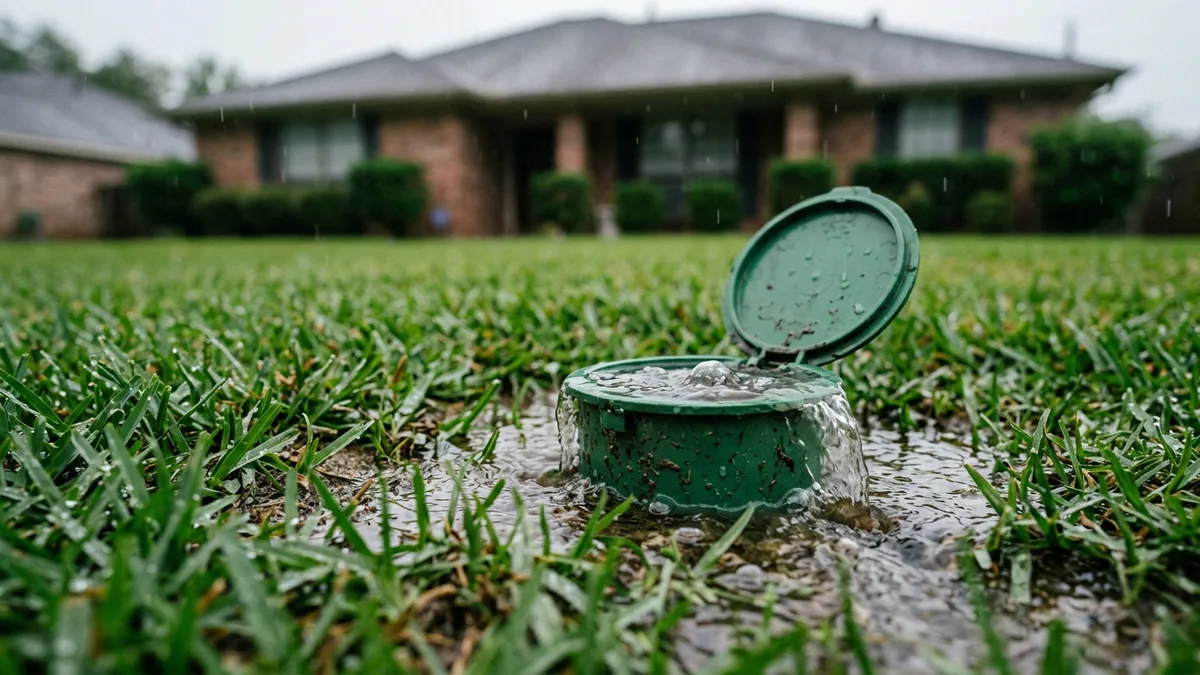
On a flat Houston yard, the outlet often decides how the whole drain is built. A pipe to the street has to slope gently downhill all the way. On lower ground, the pipe ends in a pop-up emitter (a small cap in the lawn that opens to let water out). Where neither works, a sump pump lifts the water away.
A dry well (an underground pit filled with stone) needs soil that takes in water quickly. To check, an installer digs a test hole (a hole filled with water to see how fast it drains). The common rule is that it should empty within 4 hours, and a lot of Houston's clay drains more slowly. See dry wells and other outlets compared.
Tying a driveway drain into the storm sewer (the pipes under the street that carry rain away) is less common. At the time of writing, a Storm Sewer Permit from the City of Houston costs $128.81 for that connection.
How is driveway or patio drainage installed?
Driveway and patio drains go in through six steps, from marking buried lines to a water test:
- Mark buried lines. The installer first calls 811 (the free number that gets buried utility lines marked).
- Pick the outlet first. The outlet's height decides how deep the drain and the pipe can sit.
- Cut and dig. The concrete is cut, and the trench is dug so it slopes slightly toward the outlet.
- Set the drain and pipe. The channel is set in concrete, and solid pipe runs to the outlet.
- Patch the concrete. The cut is finished level with the grate.
- Test with water. A hose is run to check that the water reaches the outlet.
Can I fix driveway drainage myself?
Fixing driveway drainage yourself depends on the job. A short plastic channel at the edge of a patio is a simple project for a handy person. A driveway is harder: the concrete is cut with a saw and patched to match, and the pipe needs a steady downhill slope. On a flat Houston yard with slow-draining clay, finding somewhere for the water to go is the hardest part. If the slope or outlet is wrong, the concrete has to be cut open again, and a professional may charge for the whole job.
What does driveway and patio drainage cost?
Based on several national price guides, a channel drain costs about $30 to $125 per foot installed. For a drain 20 feet long across a two-car driveway, that is about $600 to $2,500.
Other parts add to that when the lot needs them. A catch basin (a box in the ground with a grate on top) costs about $500 to $2,500 installed. A sump pump with a new pit costs about $750 to $1,800, and regrading the ground past a patio about $700 to $4,500. These are national figures, estimated for this page from several price guides, not a survey of Houston prices.
A good quote (a written price) lists the concrete work, the outlet, soil removal and lawn repair, so you know what the price covers. For prices across every service, see what drainage work costs in Houston.
Driveway and patio drainage covers Houston and nearby towns like Pearland, League City and The Woodlands.
Getting an Accurate Quote for Driveway and Patio Drainage in Houston
Call the number above or fill in the form below to get a free quote with no obligation.
FAQ
Disclaimer: The information on this page is for general information only. It should not be taken or relied on as engineering, construction, legal, financial or other advice. It is based on information that was publicly available at the time of writing, and it may have changed since. It may be inaccurate or incomplete. Always consult a professional. You use this information at your own responsibility and risk, and we take no responsibility for it.
Some content may be written with AI and then reviewed by a person.