Backyard drainage options - ai picture
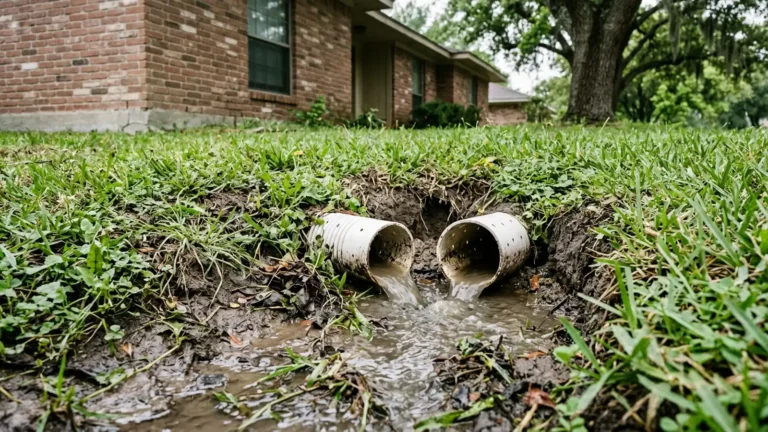
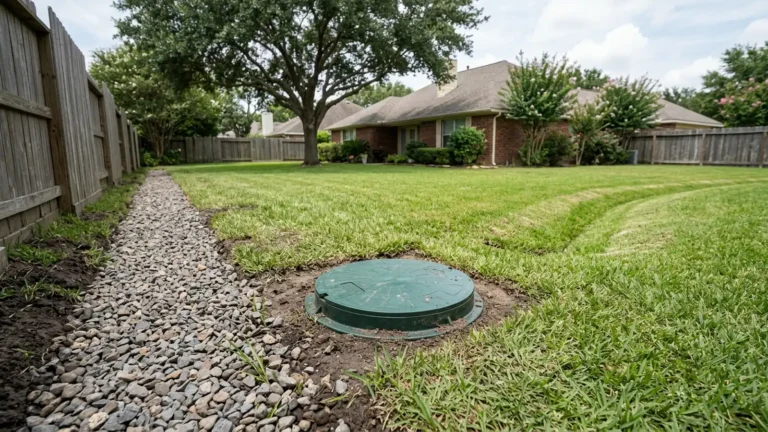
A French drain (a trench filled with gravel, with a pipe at the bottom) moves water that has soaked into the ground. A swale (a shallow, grassy ditch) moves water running across the surface. A dry well (an underground pit filled with stone) stores water so it can soak away. On a flat Houston clay yard, the key question is where the water can finally go. That often makes the dry well a poor fit.
Here is how each one works, what it costs on national figures, and two simple checks that point to the right one for your yard.
What does each system actually do?
The three fix different water problems. A French drain catches water under the surface and pipes it away. A swale carries surface water along a gentle dip in the lawn. A dry well is a buried store that lets collected water seep into the soil. The three are often combined.
| French drain | Swale | Dry well | |
|---|---|---|---|
| Handles | Water in the soil | Water running on the surface | Water piped in from a drain or downspout |
| Needs | Slope to an outlet | Slope along its length | Soil that takes in water |
| Visible | Barely (a strip of lawn) | A gentle dip in the yard | A small lid in the lawn |
| National cost | $15 to $80 per foot | $700 to $4,500 to regrade | $1,500 to $4,500 in total |
Costs are national figures, each estimated from several cost guides, not a survey of Houston prices. For prices by length, see what each option costs in Houston.
When does a French drain win?
A French drain wins when the ground stays soggy along a strip for days. Such strips are often by a fence, a patio or the side of the house. It also needs somewhere lower for a pipe to send the water. A French drain works under the lawn, so the yard keeps its shape.
In heavy clay the trench often needs to be deeper than many national guides suggest. Otherwise silt (tiny bits of soil that wash in and block it) can close it up. The details are on the page about French Drain Installation in Houston. A French drain still needs an outlet (the place where the water comes out). That can be the curb, a lower corner, a catch basin (a box in the ground with a grate on top) or a pump.
When does a swale win?
A swale wins when water runs across the yard on the surface. It may run toward the house in a wide, thin sheet or come across from a neighbor's yard. The yard also needs a little slope toward the street or a back corner. A swale is shaped from the soil that is already there, so there is no pipe to clog.
Its limits are space and slope. A swale takes up a strip of yard. It needs a slope along its whole length, often at least 1 percent (about 1 inch of drop for every 8 feet). On a dead-flat yard the water just sits in it. The page on swale drainage explains how much slope water needs, and how a yard is reshaped without raising it.
What does a dry well do, and does it work in Houston clay?
A dry well holds water and lets it soak into the soil around it. It only works where the soil takes in water fairly fast. Houston clay is rated very high for swelling and shrinking, and it takes in water slowly. In the sandier ground to the northwest, a dry well has a better chance.
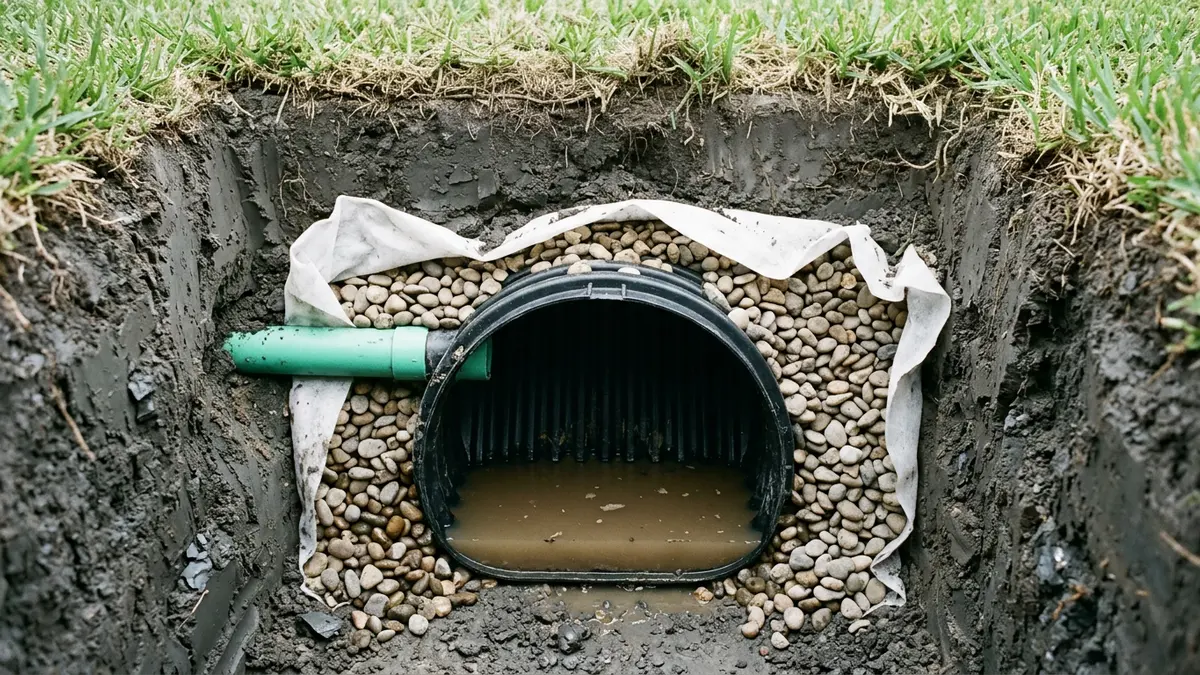
A common rule settles it. Dig a test hole (a hole filled with water to see how fast it drains). If the hole still holds water after 4 hours, a dry well is a poor fit. On clay that swells and closes up when wet, many yards inside the city may fail this test.
Size is the other problem. A typical dry well of about 36 by 36 inches holds about 50 gallons. A 1,000 square foot roof collects about 623 gallons for each inch of rain. So the dry well is full after less than a tenth of an inch of rain from the roof alone. This is a simple sum from the roof figure; no yard was measured. NOAA (the US weather agency) puts a 10-year storm (1 in 10 chance each year) in downtown Houston at 8.74 inches in 24 hours. Against that, the dry well fills almost at once.
A dry well still has a place where the soil drains and the amount of water is small. On a sandier yard, that can mean a dry well for driveway and pool deck runoff, if the test hole passes. Where the soil will not take water, a catch basin or a channel drain (a long, narrow drain with a grate on top) does the job instead. It is piped to a curb outlet or a pump.
Can you combine them?
Yes, and many Houston yards need two. A swale can carry surface water to a catch basin at its low end, and the basin pipes it to the curb. A French drain can collect water along a fence and empty into the same basin. On a sandy yard, a dry well can take the extra water.
One combination to avoid is roof water poured into a French drain. The drain's perforated pipe (plastic pipe with small holes) lets roof grit (loose gritty bits from the shingles) into the rock. Gutters should get their own sealed pipe, or a basin that traps grit, before they meet the drain.
How do you choose for your own yard?
Find the slope first, then test the soil. After a normal rain, watch where the water goes. If it runs across the surface, think swale. If it soaks in and the ground stays soft, think French drain. Then look for the lowest place where the water could leave the yard.
- Find the slope. Is there a curb, ditch or corner lower than the wet spot? If yes, water can flow there, and a French drain or swale can work.
- Test the soil. If there is no slope, a test hole that drains in under 4 hours means a dry well might work.
- Plan a pump if both fail. No slope and clay that drains slowly mean a small sump pump (a pump that pushes water out when it cannot flow downhill) has to do the job.
A free assessment covers both checks and puts the numbers in writing. To see every option side by side, read about yard drainage options for your lot.
FAQ
Disclaimer: The information on this page is for general information only. It should not be taken or relied on as engineering, construction, legal, financial or other advice. It is based on information that was publicly available at the time of writing, and it may have changed since. It may be inaccurate or incomplete. Always consult a professional. You use this information at your own responsibility and risk, and we take no responsibility for it.
Some content may be written with AI and then reviewed by a person.