

French drain trench - ai picture
A French drain (a trench filled with gravel, with a pipe at the bottom to lead water off) is a common fix for a wet yard. Based on national price guides, French drain installation cost in the Houston area is estimated at $15 to $80 per linear foot (each foot of drain length). That is about $1,500 to $8,000 for a 100-foot drain. Houston's clay soil pushes most jobs toward the higher end, because a shallow trench does not last long in clay. This page shows what drives the price, from drain length and materials to what a quote (the written price from the installer) should include. To learn how the drain itself works, see French Drain Installation in Houston.
How much does a French drain cost by length?
The price depends mostly on how long the drain is. The table below shows a basic job at typical rates next to a deeper job built for clay. Extras are priced on top, as shown further down.
| Length | Basic job ($15-45/ft) | Deeper job built for clay ($35-80/ft) |
|---|---|---|
| 25 ft | $375 - $1,125 | $875 - $2,000 |
| 50 ft | $750 - $2,250 | $1,750 - $4,000 |
| 100 ft | $1,500 - $4,500 | $3,500 - $8,000 |
| 150 ft | $2,250 - $6,750 | $5,250 - $12,000 |
| 200 ft | $3,000 - $9,000 | $7,000 - $16,000 |
| 250 ft | $3,750 - $11,250 | $8,750 - $20,000 |
The per-foot rates are an estimate based on four national price guides. The table multiplies those rates by each length. They are not a survey of Houston prices.
Most Houston yards need 50 to 150 feet of drain to fix one wet spot or one side of the house. A typical 100-foot drain costs $1,500 to $8,000 across the two columns above.
What makes the price higher in Houston clay?
Houston's heavy clay can add cost in three ways, and each one means more work or more materials.
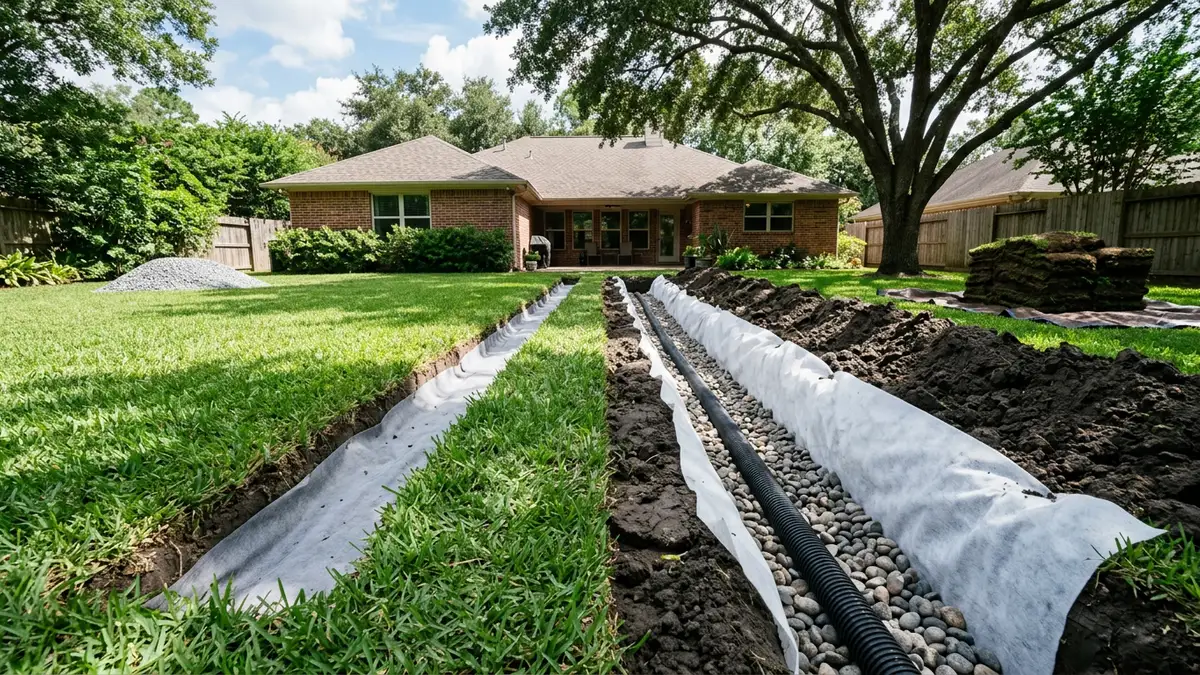
Trench depth. National guides often say a trench 12 to 18 inches deep is enough. Houston clay often needs a trench more than 2 feet deep. A shallow trench may only dry the ground right next to it. A deeper trench takes longer to dig, so the labor (the workers' pay) costs more.
Digging time. Clay is slower to dig than sandy soil. By hand, a crew usually digs 4 to 8 feet of trench per hour in Houston clay. In sandy soil, it digs 8 to 12 feet per hour. A small digging machine is faster, but renting one adds to the cost on a small job.
Fabric weight. The trench is lined with filter fabric (a cloth that lets water in but keeps soil out), which comes in light and heavy weights. Heavier fabric is stronger but costs more per foot, so the installer picks the weight that suits the soil.
What does a quote pay for, line by line?
A quote mostly covers four things: the pipe, the stone, the filter fabric and the work of digging and refilling the trench. Very few websites show this line by line, so here is a breakdown for a standard 4-inch system, priced per foot of drain. Materials are the smaller part of the bill. Labor is the bigger part, and in clay it depends on how long the digging takes.
| Item | Cost per foot |
|---|---|
| 4-inch pipe, perforated (with small holes) or solid | $1 - $2.50 |
| Washed stone | $1.50 - $3.50 |
| Filter fabric | $0.50 - $2 (heavier fabric costs more) |
| Labor (landscaper $45-110 an hour, plumber $45-150 an hour) | Depends on digging time |
Each range is an estimate worked out from three or more national price guides.
A 100-foot drain usually needs about $300 to $800 in materials, and labor makes up the rest. That is why the price of a 100-foot drain can vary so much. A trench 18 inches deep with light fabric costs less than one 30 inches deep with heavier fabric. Both are called a French drain, but in Houston clay the deeper one usually works better.
What should a French drain quote include?
A good quote says clearly what is included. Check that it covers:
- fixing the lawn over the trench, with new sod (rolls of ready-grown grass) or seed
- taking away the dug-out soil
- permit fees, if the job needs a permit
- extra charges for yards that are hard to reach
- the outlet (the place where the drain lets the water out), which is sometimes priced on its own
If a quote does not mention one of these, ask about it, so it is clear what the price covers. To get a price for your own yard, you can book a free assessment.
What do catch basins, pumps and regrading add?
Catch basins (boxes in the ground that collect water under a grate), pumps and regrading (reshaping the ground) usually add about $500 to $4,500 each. These extras are for yards where a French drain alone is not enough, or is not the right fix. The most common ones are catch basins and channel drains (long, narrow drains with a grate on top). Another is a yard sump pump (a pump that pushes water out of the yard when it cannot flow downhill). The table shows each option, its usual cost and when it is the right choice.
| Option | Typical cost | When it is the right choice |
|---|---|---|
| Catch basin | $500 - $2,500 installed | One low spot with standing water, not a long wet strip |
| Dry well | $1,500 - $4,500 | Rarely a good fit in Houston clay (see below) |
| Yard sump pump | $750 - $1,800 | When water cannot flow downhill to lower ground, which is common on flat lots |
| Driveway and patio drain (a channel drain across the concrete) | $30 - $125 per foot | Water running toward the garage or the back door |
| Yard grading, regrading and erosion control (reshaping the ground so water flows away, and stopping soil from washing away) | $700 - $4,500, more for a large yard | When the ground slopes toward the house |
| Cleaning or repairing an existing drain | $75 - $600 per visit | A drain you already have that is clogged or damaged; cleaning is usually needed every 1 to 2 years |
| Perc test (a test of how fast water soaks into the soil) | $250 - $1,750 | Before paying for a dry well |

National figures, each estimated from three or more price guides, not a survey of Houston prices.
A dry well (an underground pit filled with stone) only works if the soil soaks up water fast enough. To find out, an installer digs a test hole (a hole filled with water to see how fast it drains) and times it. If the water takes more than 4 hours to drain, that's a bad sign. Most Houston yards sit on expansive clay (clay that swells when wet and shrinks as it dries). Water drains from a test hole in that clay much more slowly than that. A dry well quoted without this test first may not work.
Rain from the roof often adds to the problem. Downspouts (the pipes that bring rain down from the roof gutters) can drop it right next to the house. In that case, downspout and gutter drainage may be part of the fix. Is water sitting next to the house, or in the crawl space (the low, open space under some houses)? Then look at foundation and crawl space sump pump work. Not sure which option suits your yard? The page on yard and lawn drainage compares the main options.
Which Houston permits can a drainage job need?
At the time of writing this, the City of Houston has not published any requirement for a permit specifically for French drains. Its permit pages list three permits that can come up in drainage work. One of them is for water that goes into the storm sewer (the pipes under the street that carry rain away). Each permit has a set fee:
- Storm Sewer Permit: for connecting to the City storm sewer from inside your property. The fee is $95.25 plus a $33.56 administration fee (a charge for handling the paperwork), which makes $128.81 in total. The permit comes from the Office of the City Engineer.
- Roof drain or outside downspout permit: for connecting downspouts to a drainage system. The fee is $34.24 for the first two downspouts and $11.41 for each extra one. The minimum is $97.56, and the $33.56 administration fee is added. The City says a master plumber (the top plumbing license) or a drain layer (a drain pipe installer) registered with the City gets this permit. At the time of writing, the City says it does not need to check the drawings before work starts on a single-family home.
- Catch basin or outside area drain permit: for catch basin and outside drain plumbing. It has the same fees as the roof drain permit, and a master plumber registered with the City gets the permit.
Which permits a job needs depends on where the water ends up: in the yard, in the street, or in the City's storm sewer. A licensed local contractor can tell you before work starts, and the permit fee then appears as its own line on the quote.
Can you install a French drain yourself?
Yes and no. Here's the explanation: a short, shallow French drain in sandy soil can be a do-it-yourself job, but you'd first need hours of reading and shopping for materials, and one mistake would end with you having to bring in a professional. Installing a French drain in Houston is harder. The ground here is mostly clay, so the trench takes longer to dig and has to go deeper. The pipe needs a steady downhill slope from end to end, and the filter fabric has to suit the soil. So, just for example, too little slope can leave the drain holding water - which would mean a professional digging up the trench and rebuilding it - costing you almost double the time and money.
Is Houston more expensive than other cities?
Many people expect a big city to cost more, but price guides from contractors in other cities do not show that. At the time of writing, the per-foot prices in guides from Seattle and Atlanta fall inside the national range used on this page.
The price range inside any one city's guide is wider than the difference between cities. The size of the job matters most: length, depth and extras. Houston's clay does mean deeper trenches and heavier fabric, but that comes from the soil, not from higher prices in Houston.
Installers work in Houston and nearby towns such as Pearland, League City and The Woodlands. See the full service area.
Getting an Accurate Quote for French Drain Installation in Houston
Call the number above or fill in the form below to get a free quote with no obligation.
FAQ
Disclaimer: The information on this page is for general information only. It should not be taken or relied on as engineering, construction, legal, financial or other advice. It is based on information that was publicly available at the time of writing, and it may have changed since. It may be inaccurate or incomplete. Always consult a professional. You use this information at your own responsibility and risk, and we take no responsibility for it.
Some content may be written with AI and then reviewed by a person.