
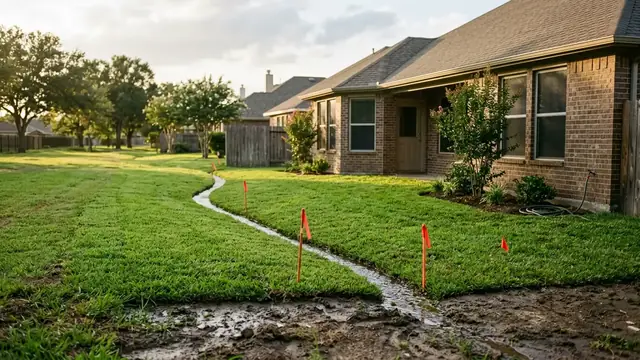
Graded backyard swale - ai picture
Yard grading (reshaping the ground so it slopes the right way) makes rain run away from your house. The water goes to an outlet (the place where it leaves your yard). On a flat Houston clay yard, this usually means swale drainage (water led away in a shallow, grassy ditch). It also needs the right slope next to the house and a working outlet. Grading is often the cheapest fix, and sometimes no drain is needed after it.
The free estimate starts by checking how much slope the yard really has.
When is grading the fix instead of a drain?
Grading is the fix when the slope is the cause. If water runs toward the house, sits in a low spot, or pools where the ground has sunk, a drain only treats the symptom. Changing the shape of the ground removes the reason the water is there.
- Water runs toward the house after a storm instead of away from it.
- A low spot holds water in the same place every time.
- Soil has sunk beside a patio, pool or old trench, leaving a dip.
- Flower beds or mulch have built up until they trap water against the wall.
If water seeps in from the side, or the soil stays soaked, a drain may be the better tool. See yard drainage for how to tell the two apart.
Many Houston yards need both. The slope points the water the right way. Then a French drain (a trench filled with gravel, with a pipe at the bottom) collects what the slope cannot move. A catch basin (a box in the ground with a grate on top) can also do that job.
How much slope does water need?
Next to the house, the ground should drop about 6 inches over 10 feet, under the International Residential Code (a standard set of home-building rules). After that, a common guide is at least 2 percent (2 feet of drop for every 100 feet) toward the outlet. Patios within 10 feet of the house should drop about a quarter inch per foot. On a flat Houston yard, these numbers decide what is really possible.

Six inches in 10 feet is a 5 percent slope, but only the strip next to the house needs that slope. For example, take a house 60 feet from the back fence. The first 10 feet drop 6 inches, and the other 50 feet, at 2 percent, drop another 12 inches. So the ground at the fence must be about 18 inches lower than the ground at the house. This example comes from the slope rules. It is not a measurement of any yard.
Many Houston yards do not have 18 inches to spare. The fence, street or ditch may be only a few inches lower than the house. Then water cannot flow downhill to the outlet. A catch basin, or a pit with a small sump pump (a pump that pushes water out when it cannot flow downhill), takes over.
What is a swale, and how does it drain a yard?
A swale is a wide, shallow, grass-covered dip that carries rain across the lawn to an outlet. Nothing is buried in it, so it cannot clog the way a pipe can. It suits a yard that slopes gently toward a street, ditch or basin. It does not work on a yard with no slope at all.
Since a swale is only dug and shaped, it is often the cheapest way to move water that runs over the ground. It uses up a strip of lawn, and the ground along its full length has to slope down toward the outlet. A French drain is the better tool for water moving under the ground. A dry well (an underground pit filled with stone) is a third choice. The comparison of French drain vs dry well vs swale shows which one fits which yard.
How is a yard regraded?
A yard is regraded in five steps, in this order, so the water keeps running the right way.

- Measure. Call 811 (the free number that gets buried utility lines marked), then use a laser level to measure how high the ground is.
- Lift the grass. Sod (rolls of ready-grown grass) and topsoil are set aside to go back on top.
- Shape the soil. Soil moves from high areas to low ones. Shaping a swale moves less soil than raising the whole yard.
- Pack and finish. New soil is packed down in layers, because loose soil sinks and brings the dip back.
- Put the lawn back. Sod or seed goes back, and the next heavy rain is the real test.
After the work, the water must stay on your own yard or go to a proper outlet. This is because section 11.086 of the Texas Water Code says that "no person may divert or impound the natural flow of surface waters" in a way that damages another person's property by overflow.
How do you drain behind a retaining wall?
Water that builds up behind a retaining wall (a wall that holds soil back) pushes on the wall. So the water needs a path to leave. The usual setup has clean gravel behind the wall and a perforated pipe (plastic pipe with small holes) at the base, sloped to an outlet. Filter fabric (a cloth that lets water in but keeps soil out) keeps soil out of the gravel.
Retaining walls are less common on flat Houston yards. They do show up around raised pool decks, planter beds and driveways. Houston clay swells when wet and holds water against the back of a wall, so the drain matters more here than the wall's height suggests. A wall with no drain is usually fixed by digging along its back and adding gravel and a pipe to a working outlet.
What stops erosion on a Houston yard?
Erosion is when moving water cuts into bare or steep ground. The fix is to slow the water, spread it out, cover the soil and give it a firm outlet.
NOAA (the US weather agency) has rainfall estimates for Houston. They put a 100-year storm (a storm with a 1 in 100 chance each year) at 17.0 inches in 24 hours downtown. Bare clay seals up under rain like that, so the water runs off fast and cuts channels.
- Cover the soil with sod, seed under an erosion blanket (a mat that holds seed and soil in place), or mulch on slopes.
- Spread the flow with shallow swales and low berms (small, long mounds of soil).
- Protect the channel with rock where water has to gather, such as a gap between two yards.
- Protect the outlet with a bed of rock, so the water does not dig a hole where the pipe ends.
What does yard grading cost in Houston?
The cost depends mostly on the size of the area and how much soil is moved. Based on several national price guides, this work costs about $700 to $4,500, and more for a large yard. Room for machines, distance to the outlet and lawn repair change the price most.
Those are national ranges, not a Houston survey. See the cost of drainage work in Houston for what a quote should include.
Yard grading, retaining wall drainage and erosion control are available in Houston and nearby towns such as Pearland, League City and The Woodlands.
Getting an Accurate Quote for Yard Grading in Houston
Call the number above or fill in the form below to get a free quote with no obligation.
FAQ
Disclaimer: The information on this page is for general information only. It should not be taken or relied on as engineering, construction, legal, financial or other advice. It is based on information that was publicly available at the time of writing, and it may have changed since. It may be inaccurate or incomplete. Always consult a professional. You use this information at your own responsibility and risk, and we take no responsibility for it.
Some content may be written with AI and then reviewed by a person.