
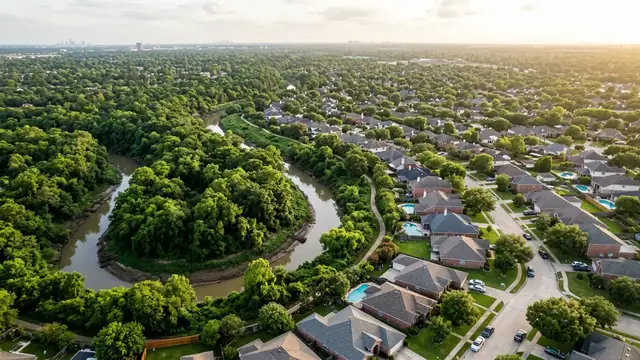
Houston neighborhood aerial - ai picture
Across Houston, installers put in French drains (trenches filled with gravel, with a pipe at the bottom) and other yard drainage. The area covers more than 40 nearby towns and neighborhoods, and every job starts with a free assessment, wherever you live. The soil, the slope and the outlet (the place where the water leaves) change from one part of the area to the next.
Here is every area served: Houston, Bellaire, West University Place, Memorial, Memorial Villages, Tanglewood, River Oaks, The Heights, Garden Oaks / Oak Forest, Rice Military, Montrose, Spring Branch, Meyerland, Braeswood Place / Braes Heights, Jersey Village, Energy Corridor, Bear Creek, Copperfield, Katy, Cinco Ranch, Fulshear, Sugar Land, Missouri City, Richmond, Rosenberg, Pecan Grove, Sienna, Cypress, Bridgeland, Champions, Tomball, Spring, The Woodlands, Magnolia, Humble, Atascocita, Kingwood, Porter, Pearland, Friendswood, League City, Clear Lake and Deer Park. If yours is close to one of them but not listed, call xxx-xxx-xxx and ask.
What drainage work is done in these areas?
The same drainage work is done everywhere on the list. It covers French drain installation across Houston and yard and lawn drainage. It also covers reshaping the ground, catch basins (boxes in the ground with a grate on top), pipes for roof water and drain repair. Under older raised houses, water can reach the crawl space (the low, open space under the floor). There a crawl space sump pump (a pump that pushes water out when it cannot flow downhill) removes it. What changes from town to town is which of these services your yard needs.
Does the ground change across the Houston area?
Yes. Houston itself and most of the west and southwest sit on heavy clay. The northwest suburbs have sandier ground that takes water faster, and Montgomery County to the north is a mix. That one difference changes how deep a trench goes and how fast a yard dries.

Inside the city: the US Department of Agriculture's soil descriptions put most of Houston on a clay soil named Lake Charles clay. This is the grey-black gumbo (sticky, heavy clay) that many Houstonians know. Soil like this swells when wet and closes up, so water stays on top.
West and southwest: Katy, Sugar Land and Richmond sit mostly on clay. The soil descriptions list five soils there: Lake Charles, Bernard, Midland, Addicks and Vamont. The land is very flat, so the outlet is usually the hard part of the job.
Northwest: around Cypress, Tomball and Hockley the ground turns sandier. A soil called Wockley, a fine sandy loam (soft, crumbly soil with sand in it), was first recorded by soil scientists near Hockley. This is also Cypress Creek country. The Harris County Flood Control District says the creek's watershed (all the land that drains into the creek) covers 267 square miles.
North: Spring, The Woodlands, Magnolia and Porter reach into Montgomery County, where the soils are mixed. Two of those soils are called Splendora and Conroe. A test hole (a hole filled with water to see how fast it drains) shows which kind your yard has.
The Heights and other older areas: the City of Houston has a manual on the historic Heights homes. It describes them as raised on piers (short posts that hold the house up). So drainage there often includes the crawl space, not only the yard.
Does price vary by town?
Not much. A drain is priced by its length, its depth, the outlet and the repair of the lawn. Those depend on the yard, not the zip code. The clay areas often need deeper trenches than the sandier northwest, and that moves the price more than the town name does. See what a French drain costs in Houston.
Who sets the rules where you live?
It depends on the address: inside the City of Houston, City permits can apply to some drains. One case is a drain that connects to the storm sewer (the pipes under the street that carry rain away). Another is downspouts (the pipes that bring rain down from the roof) connected to a drain. Bellaire, West University Place, Sugar Land, Pearland and the other cities have their own permit offices. Outside city limits, the county may set the rules.
Many homes in the suburbs are also in a utility district (a local district that provides water and drainage services). A district may have its own drainage rules. The installer checks which one applies to your address before work starts.
Ready for a free drainage assessment?
A free assessment shows where the water sits, where it can go and which service fits. It works the same way wherever on the list you live. Call xxx-xxx-xxx, fill in the quote form below, or request a free drainage assessment.